Nature
 PUBLISHED
 2
2


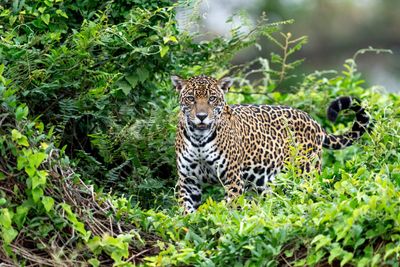


Footage captured on camera traps in southeastern Brazil may be the first-ever recording of jaguars meowing.
It is well known that Panthera species – tigers, lions, jaguars, leopards, and snow leopards – can make roaring noises thanks to their larger vocal cords. It was thought, however, that jaguars and other large cats can’t meow due to these vocal cords and the morphology of their hyoid bones. And yet, this new footage of jaguars recorded in Iguaçu National Park begs to differ.
Iguaçu National Park is a protected area made up of humid rainforest and deciduous forest, and is known as a critically important area of jaguar habitat, holding a large proportion of the jaguar population.
The camera traps were installed as part of a continuous monitoring program that works with jaguar conservation in the area. There were 29 cameras placed roughly 1-2 kilometers (0.6-1.2 miles) apart at different locations to monitor the wildlife species in these areas.
The team found three recordings of unusual vocalizations in jaguars from the camera traps. Two of them were related to an adult female jaguar searching for her cub, and one recording was from a young female that the team thought was searching for her mother.
The first recording was taken in April 2022, with the adult female walking along a trail her six-month-old cub had walked along the previous day alone. Three vocalizations were recorded with a four to five-second gap between them.
In December, the same jaguar made a vocalization lasting 0.7 seconds. This recording was made a few days after the female had been seen with a cub thought to be around two months old. The jaguar was alone in the video.
A different jaguar, thought to be one year old, was seen walking with its sister and recorded on the camera trap making four vocalizations. The team thinks the calls were to her mother, who was not recorded but thought to be nearby. At this age, the jaguar adolescents are beginning to disperse and become more independent from their mother.
The team thinks that these vocalizations resemble a meow, a noise not previously thought to be made by jaguars. “Despite each vocal unit [exhibiting] distinct acoustic features, they all closely resembled a meow—sharp, brief, and emitted in a sequence similar to the meows of domestic cats,” the authors explain in the paper.
“As far as we know this is the first time that jaguars have been recorded using this kind of communication, which we are incredibly excited about,” said Dr Marina Duarte, Research Fellow at the University of Salford, in a statement.
Despite the small sample size, the team notes that the vocalizations all happened between females and their cubs, and may be related to situations in which they are temporarily separated. Cubs typically still stay with their mothers until two years old, gradually gaining their own independence. It is even possible that the mother would be able to discern the call of her cub from others; the team thinks that the benefit of receiving care and attention from the mother via the call would outweigh any potential predation risk of another animal hearing the meows.
“This research really deepens our knowledge of how big cats can communicate. We think they are making these sounds to help locate their young but they could also be using them for reproductive purposes too, to find a mate perhaps. It does sound very cute to our ears!” said Duarte.
“These results highlight the value of long-term monitoring efforts for this iconic Atlantic Forest species and show that there is still much to learn about how jaguars interact and communicate in their natural environment,” added Vania Foster, Head of Research of the Project Jaguars of Iguaçu.
The study is published in Behaviour.