Health and Medicine
 PUBLISHED





What you’ll discover in this article
- Scientists at the University of Michigan have developed a new method of producing flu vaccines using yeast.
- By targeting a different protein than conventional shots, they hope to produce a vaccine that protects against multiple strains of flu at once.
- Graduate student Isabel Vanderzee told IFLScience that even looking beyond flu, this is “a really promising platform that’s been unlocked that could be applied to other enveloped viruses like COVID or HIV.”
Depending on where you are in the world, you’re either just coming out of a flu season or just about to go into one.
For us in the Northern Hemisphere, August marks the beginning of the end of summer break and thoughts starting to turn towards falling leaves, Halloween, and – dare we say it – the holiday season. And for many of us, that includes scheduling our annual flu shots.
Many scientists hope that it will soon no longer have to be this way – that the yearly flu shot will become a thing of the past as new technology and discoveries open the door to a broadly protective or even universal flu vaccine.
IFLScience spoke to researchers at the University of Michigan who have come up with a fascinating new method that could one day make this a reality.
Saying goodbye to an 80-year-old process
Conventionally, flu vaccines are produced using a method that hasn’t changed much in the last 80 years.
It involves growing the viruses in chicken eggs. Scientists decide which viral strains to include based on their best models of how the next flu season will pan out, before growing enough virus using the eggs and then either weakening (attenuating) or inactivating the viruses depending on the vaccine type.
It’s time-consuming – it takes at least six months to produce vaccines this way, first author and graduate student Trang Hoang told IFLScience.
By contrast, the new method Hoang and colleagues have been working on could get functional vaccines ready in as little as one month.
It differs from the current production in major ways: the manufacturing process, the target part of the virus, and the actual composition of the vaccine itself.
First off: we skip the eggs, and use yeast instead.
A new way to make a flu vaccine
“Yeast have previously been used to make virus-like particle vaccines for viruses such as human papillomavirus [HPV] or hepatitis B,” Hoang told us.
“However, those viruses are non-enveloped, whereas influenza is an enveloped virus, so requires the budding off process.”
This is where a newly produced virus particle steals a bit of a cell’s outer membrane, wearing it like a protective coat as it leaves the cell and spreads the infection further in the body.
This is a critical part of virus particle formation for enveloped viruses. It works well in animal cells, but not so much in yeast, which have rigid cell walls.
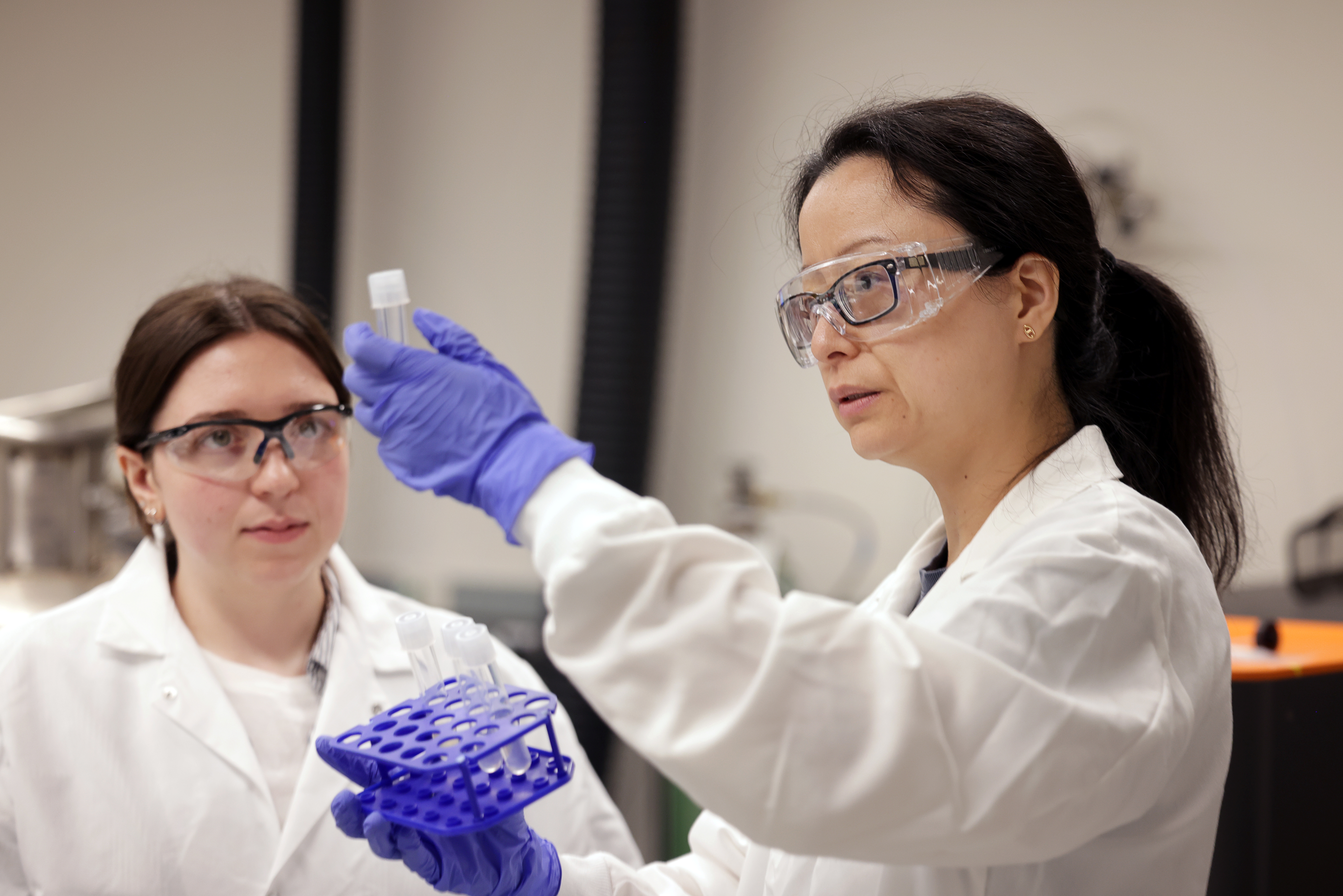
Hoang and the team at Michigan, supervised by Professor Fei Wen, are the first to be able to get around this problem.
I presented this result and another lab [came] and asked me how to do [it].
Trang Hoang
“We had to open up that cell wall to allow the budding. […] That’s a new concept that we introduced here to produce [virus-like particles] for an enveloped virus,” said Hoang.
“The other options to produce virus-like particles are typically mammalian cells or insect cells. Those are more commonly used,” added fellow graduate student and co-author Isabel Vanderzee.
“However, yeast have several advantages in that they are easier to purify the product because you have a lot of contaminants from mammalian and insect cells […]. It’s also faster […] and you can have greater yields of the vaccine in a shorter amount of time.”
Vanderzee explained that the costs are also lower and maintenance of the system easier when using yeast.
“Something that’s never been done before”
Hoang and Vanderzee both mentioned virus-like particles or VLPs, which are pretty much what they sound like: particles that are not whole viruses, are not infectious or dangerous in themselves, but which have been engineered to appear to the immune system like viruses.
Probably the most well-known example of a VLP vaccine in current use is the HPV vaccine, which has achieved stunning results in decreasing rates of cervical cancer in the vaccinated generation.
Other VLP vaccines in development include ones against polio and respiratory syncytial virus (RSV), according to a 2025 review that called the technology “versatile and promising”, and “likely to lead to highly effective vaccines”.
An exciting sidebar to Hoang and colleagues’ work is that it opens up the possibility of VLP vaccine development using the yeast method for other enveloped viruses.
“Using yeast to produce enveloped virus-like particle vaccines [is] something that’s never been done before, even outside of influenza, so that’s a really promising platform that’s been unlocked that could be applied to other enveloped viruses like COVID or HIV,” Vanderzee explained.
Of proteins and particles
The third aspect that sets this experimental vaccine apart from others is that it is based around a different influenza protein.
Typically, flu researchers focus on the two major surface proteins that are expressed on the outside of the virus: hemagglutinin (the “H” in names like H5N1) and neuraminidase.
Hemagglutinin in particular is the target of many vaccines, both the ones in use – including the latest mRNA vaccine – and ones being researched, because there’s just so much of it on the flu virus that it evokes a strong immune response.
But Hoang and the team turned their attention to a totally different protein called M2.
It’s expressed at much lower levels on the virus surface, so the human immune system largely ignores it, but the beauty of using a VLP is that you can theoretically engineer it to carry the proteins you choose. When there’s no hemagglutinin there to take all the attention, the immune system can mount a response directed at M2 instead.
This is where the “universal” aspect of this vaccine comes in. M2 serves vital functions for the flu virus – it’s intimately involved in the process of replicating the viral genome and producing whole new virus particles.
Because its function is so important, it’s highly conserved across influenza strains and doesn’t mutate anything like as often as hemagglutinin does.
It's very exciting that you might be able to get just one vaccine, or maybe one with a few boosters like COVID.
Isabel Vanderzee
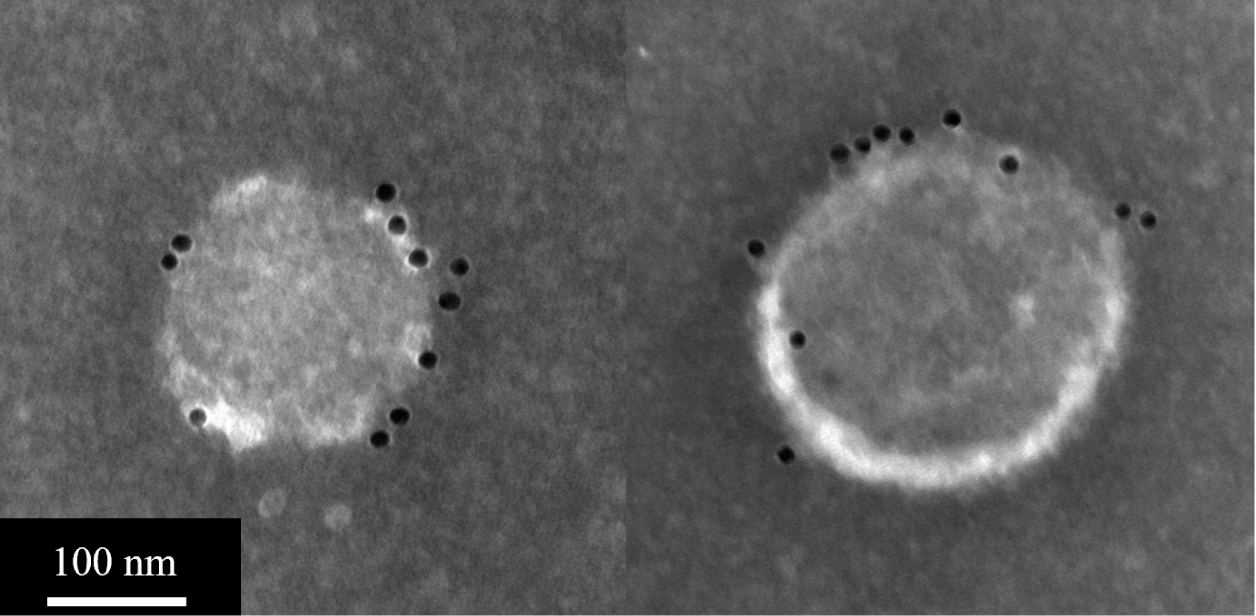
Hoang used the yeast to produce VLPs expressing M2 protein on their surface.
“With our [platform] we were able to make a lot more M2 on the surface of those particles,” she explained. “Another study tried to produce M2 VLPs in insect cells and they got 1 percent of M2 out of all the total VLP proteins. But in our case we got it to 8 percent.”
Hoang described the excitement of the first time the team saw the particles under transmission electron microscopy (TEM) and could visualize the M2: “the quality of the image [was] really good”, so much so that “I presented this result and another lab [came] and asked me how to do that TEM.”
Eighteen mice were vaccinated with the purified VLPs, and blood analysis revealed strong antibody production against M2 from five influenza strains.
When vaccinated mice were exposed to three of these strains, they were 100 percent protected against infection.
These mouse experiments represent the very early stages of what can be an extremely long process of developing a new vaccine.
Next, the team is hoping to test how long the immunity lasts in the mice, although Wen said in a statement that it will likely provide “broader and longer protection” than current vaccines and could even “last a lifetime”, or at least only require occasional boosters.
“Just the idea of being able to get one vaccine that protects against all strains instead of trying to predict the most popular three strains every year and hoping you're most accurate and then having to redo that every single year,” Vanderzee told IFLScience.
“It's very exciting that you might be able to get just one vaccine, or maybe one with a few boosters like COVID, rather than having to go through that process every single year and hoping for the best in terms of your ability to match the vaccine to the circulating strain.”
Only a matter of time
Nobody knows exactly when the next pandemic is coming, or what disease will be behind it, but historical flu pandemics have been among the most devastating global events humans have witnessed.
Whether it stems from the highly pathogenic bird flu virus that’s infecting unprecedented numbers of different species around globe, or another flu strain altogether, a flu pandemic is always a possibility.
Universal flu vaccine research like this offers the promise of shoring up our defenses against that as best we can – by seeding broadly protective immunity in the population alongside developing technologies that could be used to produce a specific pandemic vaccine in record time.
The study has been presented at the 2026 Fall Meeting of the American Chemical Society.