Health and Medicine
 PUBLISHED





What you'll discover in this article...
- A high-precision gene-editing technology is enabling researchers to investigate how mice develop from single cells to whole organisms by marking their DNA like a kind of family tree.
- Last week, two teams published their findings in major scientific papers, marking a significant stride towards a full map of the cellular divisions that produce a developing mouse.
- “Similar cell identities emerged with different lineage histories. [Now] we can investigate the boundaries of developmental plasticity,” said Magdalena Zernicka-Goetz, who is involved in separate research using the same technology, told IFLScience.
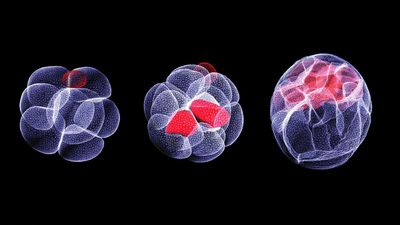
Two teams of researchers have reconstructed the family trees of over a million cells in developing mouse embryos, tracing their ancestry back through the generations to the fertilized egg.
The work gives scientists their clearest view yet of how a mammal builds itself from one cell into a three-dimensional organism made of billions of cells with hundreds of different functions.
The only animal whose entire developmental lineage has been mapped to date is a tiny transparent worm called Caenorhabditis elegans. The worm's journey from one cell into a fully-fledged adult was painstakingly documented under the microscope in the 1980s by developmental biologist John Sulston and his colleagues in the UK.
The problem is that while the worm is made up of roughly 1,000 cells, most other animals, including mammals, are vastly larger and also opaque, making this feat impossible to replicate.
Now, after nearly half a century, researchers have made a major step towards constructing a full lineage map of the developing mouse embryo – and they are using a totally different method to do it.
Instead of watching the process happen under the microscope like Sulston did, they genetically engineered mouse cells with gene-editing machinery that writes the equivalent of a genealogical tree directly into their DNA.
Heritage inside your DNA
While both teams used different versions of this technology, they work according to a common principle: every so often, an engineered gene editor inside each cell writes a small mark into its DNA. When the cell divides, its daughters inherit that mark, and their descendants add another one.
At the end of the process, the researchers are able to look at the DNA of any given cell and use its unique combination of marks to reconstruct how it is related to every other cell in the mouse.
“At the first single cell, it’s just a single branch, then that cell divides, and then you have two. And this is how your tree gets built up,” Sophie Seidel, one of the authors of the Science paper, told IFLScience.
“If the mark is installed before one cell division, then that mark is inherited to the daughter cells, and that’s how we can infer the lineage history,” added co-author Haedong Kim.
Like the old-school typewriter you write one [letter], and then you move forward to the next space [and] you write another signal.
Qi Yu
The idea dates back over a decade, and indeed the lab at the University of Washington where Kim and Seidel work, led by Jay Shendure, used an earlier version, then called GESTALT, in the zebrafish in 2016.
However, that version used CRISPR gene-editing that tended to delete some of the genealogical records as it wrote new ones, so it couldn't keep recording for very long.
The techniques in both of the new papers make use of a newer gene editing technology called prime editing, which is more precise and less destructive, enabling both teams to resolve the lineages down to individual cell divisions in some cases.
Shendure's team used a system they call DNA Typewriter. In addition to the prime-editing machinery, it uses several lengths of synthetic DNA that are introduced into the fertilized egg, which they refer to as "tapes".
Each tape has a row of sites where the gene-editing machinery can write marks, and doing this at one site unlocks the next, so the marks build up in a sequence.
“When you think of the typewriter, like the old-school typewriter, you write one [letter] and then you move forward to the next space [and] you write another signal,” said first author of the study Qi Yu, a graduate student at the Shendure lab. "So that's how we try to write on this synthetic DNA sequence that we put into the mouse."
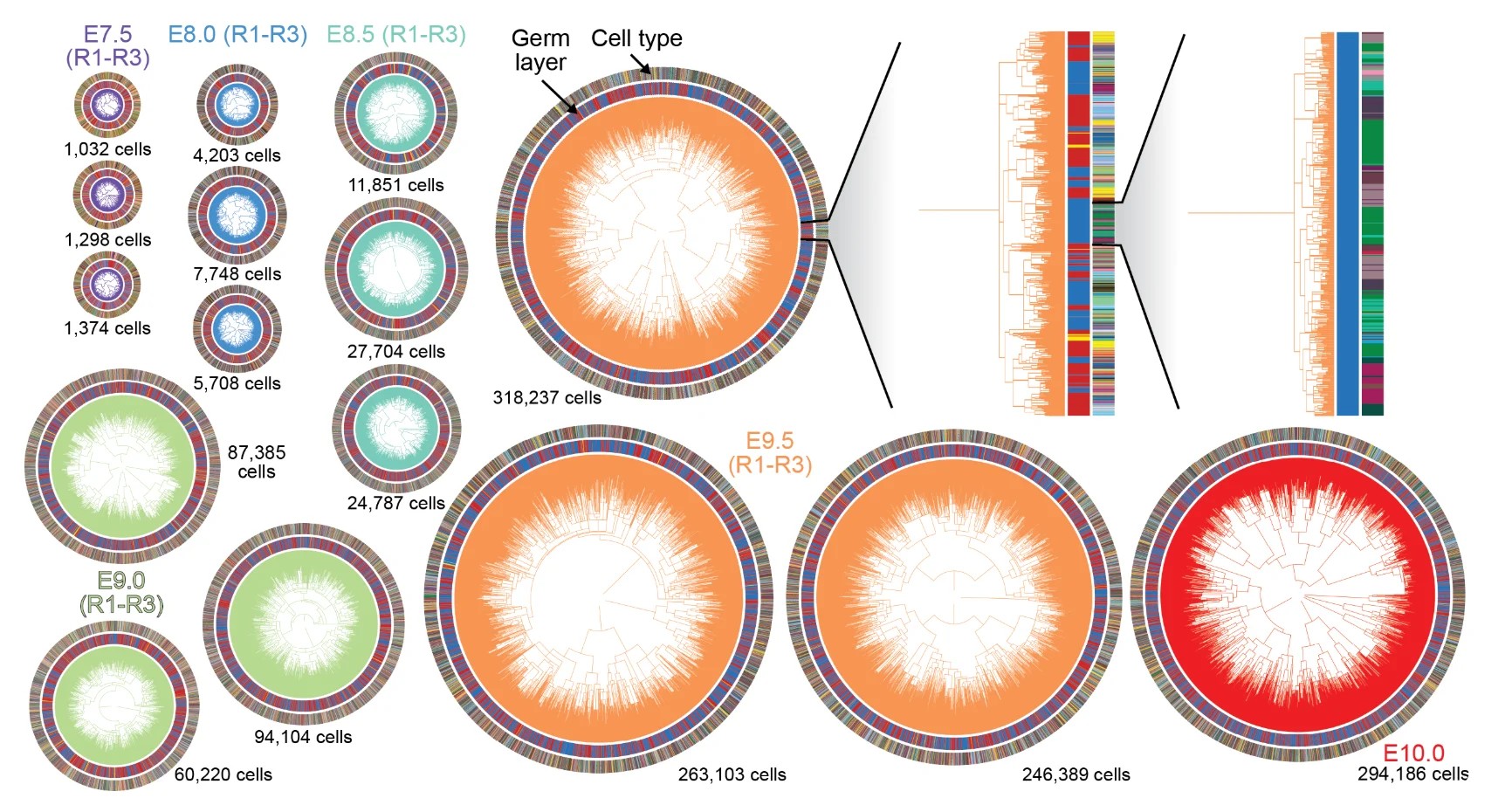
The team injected the system into a single fertilized mouse egg, let the embryo develop for 13.5 days – about two-thirds of the way through pregnancy – then read 1.28 million of its cells and worked out the most likely family tree linking them. It was no small task.
“Already if you only had 22 cells, there are more possible trees than the number of stars in the universe,” said Seidel.
Same, same but different
The Shendure team were looking at a single mouse embryo, but one of the big open questions in developmental biology is how similar the lineage maps are between embryos.
In other words, how deterministic is the process? Do the same lineages of cells end up in the same part of the body all the time, or is there an element of randomness to how the body is built?
[Now] we can investigate the boundaries of plasticity: how much those paths can change, and which aspects of a cell’s history matter for what it can do later.
Magdalena Zernicka-Goetz
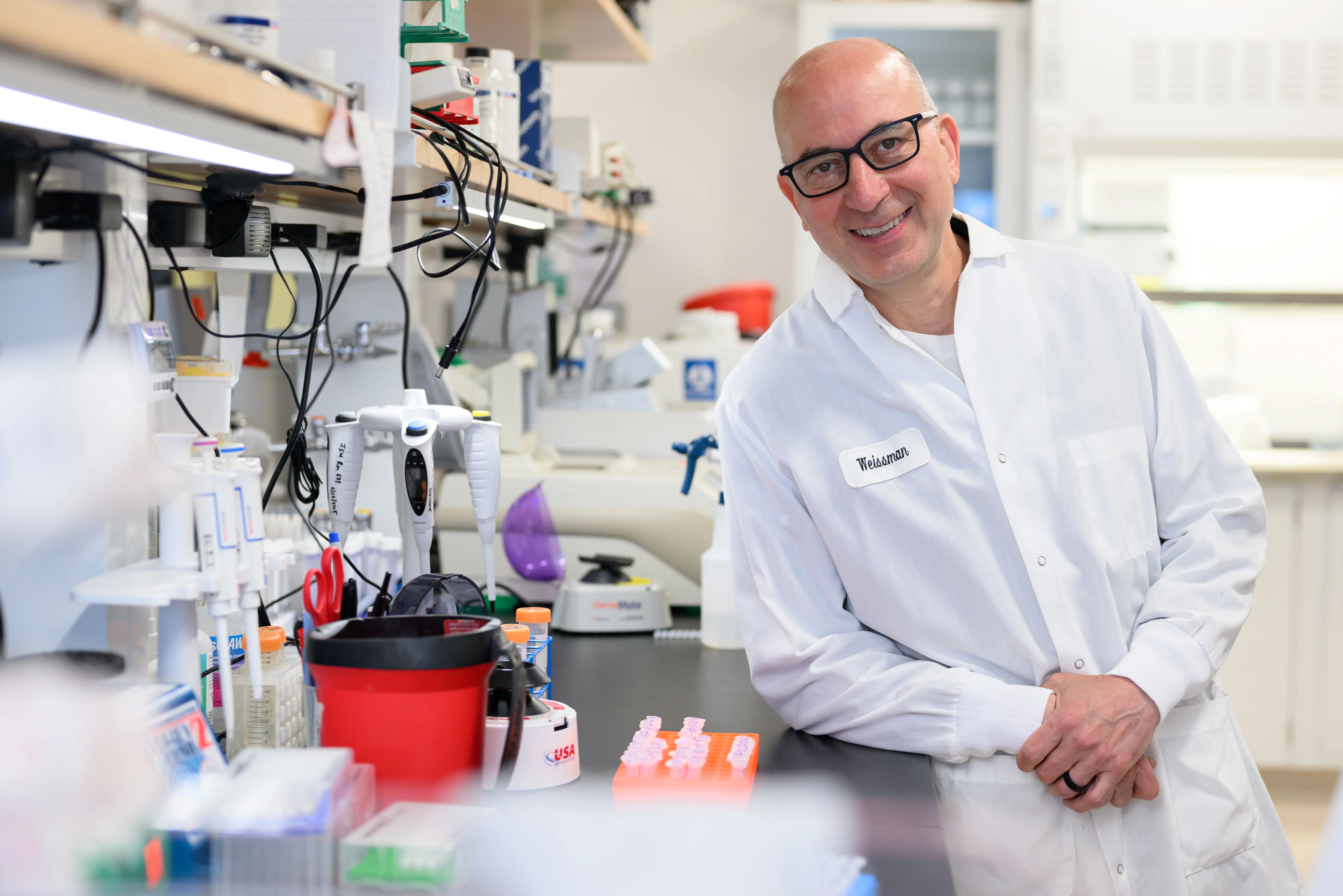
This is what the the Cell team, led by Jonathan Weissman at the Whitehead Institute in Massachusetts, set out to test that more directly.
Their version of the recording technology, called PEtracer, works slightly differently, and they apply it by editing stem cells that were added to early mouse embryos and go on to comprise a significant part of the developing organism. Using this method, they traced more than 1.4 million cells across 16 embryos.
“It’s really proof of principle that we can do what was done with the roundworm in 1983, but for mammals like you and me,” Weissman said in a statement. Weissman did not respond to IFLScience's request for comment.
The family trees produced by this method were strikingly similar between the embryos, with the timing of key branches in the tree differing by less than six hours.
Fascinatingly, in some cases Weissman's team found that a cell's location in the embryo was more important to its function than its ancestry. Cells lining blood vessels, for example, came from separate origins yet their environment molded them to act in much the same way as one another.
On the other hand, cells of the same lineage that fell on different sides of the boundary between the mid-brain and the hind-brain took on sharply different identities.
At this stage, both methods have their limitations; neither marks all the divisions in the developing embryo or manages to trace all the way to the initial egg cell without significant gaps, so the lineages are partly inferred by statistical analysis.
There are also certain parts of the developmental process that both methods are still mostly blind to, at least as far as the data presented in these papers show.
"We currently only have 11 tapes," said Seidel of the Typewriter method. "11 tapes each with six sites. So we are probably somewhere in a local neighborhood of a tree that is accurate, but by no means do we want to say that this is the true tree. Probably we are still far from that. And more development and having more tapes, having longer tapes, is really going to get us there."
Both groups have published their data to interactive websites where you can explore the PEtracer and DNA Typewriter lineage trees for yourself.
Others are already using these technologies to answer their own questions about development.
In a preprint posted last week, which has yet to be peer reviewed, a team led by Magdalena Zernicka-Goetz at Caltech – working with Junhong Choi, who helped develop DNA Typewriter – used the recorder to follow mouse development as far as day 14.5.
They also traced cells in a model built from mouse stem cells; these cells ended up looking like their counterparts in real embryos, but got there by different family routes.
“Similar cell identities emerged with different lineage histories,” Zernicka-Goetz told IFLScience. “[Now] we can investigate the boundaries of developmental plasticity: how much those paths can change, and which aspects of a cell’s history matter for what it can do later.”