Space and Physics
 PUBLISHED
 1
1



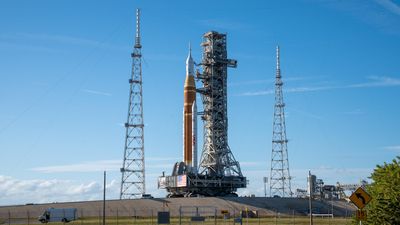


NASA has revealed some of the mementos that will fly on board Artemis II. The mission, whose first launch window opens on February 6, will be the first crewed mission of the Artemis program. NASA astronauts Reid Wiseman, Victor Glover, Christina Koch, and Canadian astronaut Jeremy Hanse will fly 9,260 kilometers (5,750 miles) past the Moon, with the potential to surpass the Apollo 13 record.
Artemis II’s Orion capsule will fly a small American flag, 33 by 20 centimeters (13-by-8-inches), with a long history of space travel. The flag has previously flown on the first space shuttle mission in 1981 and the last space shuttle mission in July 2011, as well as on the first crewed test of SpaceX’s Crew Dragon spacecraft, SpaceX Demo-2. This is not the only American flag that will travel with the mission either; the flag that was set to fly on Apollo 18, a mission that was planned but never flown to the Moon, will also fly with Artemis.
The artifacts go even farther back in time, with a 3-by-3 centimeter (1-by-1 inch) swatch of muslin fabric from the original Wright Flyer. In 1903, the Wright Brothers used the flyer to perform the first powered flight. A smaller swatch had flown on the space shuttle Discovery in 1985, and there’s a bit of it on NASA’s Mars helicopter Ingenuity, the first vehicle to fly across another world.
“Historical artifacts flying aboard Artemis II reflect the long arc of American exploration and the generations of innovators who made this moment possible,” NASA Administrator Jared Isaacman said in a statement. “This mission will bring together pieces of our earliest achievements in aviation, defining moments from human spaceflight, and symbols of where we’re headed next. During America’s 250th anniversary, Orion will carry astronauts around the Moon while also carrying our history forward into the next chapter beyond Earth.”
NASA is running several tests on the Space Launch System and Orion before launching. This will include a wet rehearsal with the rocket being fueled up and the countdown going all the way down to minus 30 seconds to launch. If everything goes according to plan, the actual launch could happen as soon as next week, with the window spanning February 6, 7, 8, 10, and 11. If it doesn’t happen, another window will open four weeks later.
Artemis II is not only carrying aerospace artifacts, but also some special soil. Artemis I carried some seeds around the Moon, similar to the Apollo 14 Moon trees. Those seeds were planted back on Earth, and some of the soil from underneath them is now going back around the Moon. The Canadian Space Agency, too, is sending seeds, and the European Space Agency, a partner in the Artemis program, will also send mementos.
We hope that the Orion Capsule will have some fun Easter eggs too, just like in the case of Artemis I, so we can try to solve all of them as the astronauts fly where no one has flown in over 50 years.