


 Space and Physics
 PUBLISHED


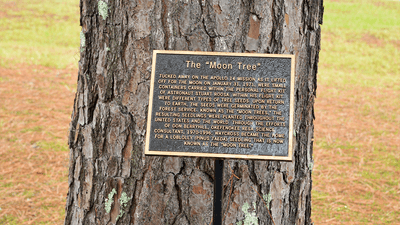


On February 5, 1971, Apollo 14 touched down on the Moon. While astronauts Edgar Mitchell and Alan Shepard took part in one of the worst rounds of Moon golf on record, Stuart Roosa, a former US Forest Service (USFS) smoke jumper, remained on board the Command Module overhead, with him a long-running experiment that would conclude years later back on Earth. That is, if we hadn't have lost track of the trees.
Ahead of the mission, the first after the infamous events of Apollo 13, Roosa was given over 2,000 seeds by Ed Cliff, Chief of the Forest Service, as part of a joint NASA/USFS project. The seeds were from loblolly pine, sycamore, sweetgum, redwood, and Douglas fir trees. They were sorted, and placed in plastic bags within a metal cannister, before being shot into space with the crew of Apollo 14.
The idea was pretty simple. The seeds would travel with Roosa as he orbited the Moon 34 times aboard the Command Module "Kitty Hawk", before being returned to the Earth. Here they would be germinated by the Forest Service, before being distributed around the US and the rest of the world, and the resulting trees compared with control seeds that remained here on the Earth. While Roosa kept the seeds safe during the flight, safely sealed inside a canvas bag, the seeds hit a bump in the road after their return to the ground.
"Unfortunately, the seed bags burst open during the decontamination procedures after their return to Earth, and the seeds were scattered about the chamber and exposed to vacuum, and it was thought they might not be viable," NASA explains.
Stan Krugman, of the Forest Service and in charge of the overall project, attempted to germinate the seeds anyway back at Houston. To NASA and the Forest Service's surprise, many of the seeds were still healthy and began to grow. However, the facilities were inadequate and many of the trees did not survive for long. The next year, many of the seeds were taken to a different facilities in Mississippi and California, and overall around 450 seedlings were successfully grown by the team.
"Some of these were planted with their Earth-bound counterparts as controls, (as might be expected, after over forty years there is no discernable difference) but most were given away in 1975 and 1976 to many state forestry organizations to be planted as part of the nation's bicentennial celebration," NASA explains, adding that the trees were only sent to countries and states where they could be grown. "A loblolly pine was planted at the White House, and trees were planted in Brazil, Switzerland, and presented to the Emperor of Japan, among others."
Along with the trees, President Gerald Ford sent telegrams to recipients of the Apollo Moon trees.
"This tree which was carried by Astronauts Stuart Roosa, Alan Shepard and Edgar Mitchell on their mission to the moon, is a living symbol of our spectacular human and scientific achievements," the telegrams read. "It is a fitting tribute to our national space program which has brought out the best of American patriotism, dedication and determination to succeed."
The trees have not been subject of much formal investigation. In fact, that would be quite difficult, as a lot of them have simply been lost, since they were planted without signs to flag up that they had been around the Moon 34 times on a spacecraft.
In 1996, NASA scientist Dave Williams attempted to catalog the location of these trees, locating around 110 of them, 30 of which had died in the intervening years, and since then Roosa's daughter has successfully distributed 12 more second-generation Moon trees, grown from seeds and cuttings from the original space-faring trees. But from what we can tell, there is little difference between the Earth trees and the trees which came close to the surface of the Moon.
Fortunately, we now have a fresh batch of Moon trees, which will hopefully be tracked more closely than their Apollo counterparts. As part of the Artemis program, NASA has once again been sending tree seeds into space, though this time they flew solo on an uncrewed 2022 mission around the Moon.
Though it will be interesting to see how their growth differs from regular Earth trees, the idea remains largely symbolic, and a way of engaging people with science and space. Seeds from this trip have been planted at 236 sites across the US, and are frequently visited by students.
“Through class visits to the tree, students have gained a lot of interest in caring for the tree,” Adria Gillespie, the district science coach at Greenfield Union School District in Greenfield, California, said in a NASA statement, "and their curiosity for the unknown in outer space sparked them to do research of their own to get answers to their inquiries."
Hopefully these trees will continue their growth, and not get lost to poor signage and time. If you happen to know where the lost Apollo Moon trees are located, NASA would like to hear from you.



 1
1