Nature
 PUBLISHED
 2
2


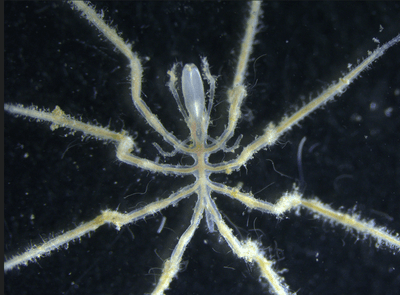


Living without sunlight ain’t easy, but newly discovered sea spiders off the US coast have evolved a remarkable survival strategy on the deep seafloor. In a world where photosynthesis isn’t an option, these spindly creatures farm methane-eating bacteria on their own bodies and then feast upon them.
Scientists at Occidental College and the California Institute of Technology recently identified three new species of Sericosura sea spiders living around methane seeps along the eastern Pacific margin. The team collected specimens from two sites in California and one in Alaska using a human-occupied submersible, called Alvin, that ventured nearly 1,000 meters (3,280 feet) beneath the surface to reach these hidden ecosystems.
It was revealed that their exoskeletons were caked in different species of methane-oxidizing bacteria, including Methylomonadaceae, Methylophagaceae, and Methylophilaceae. Through chemosynthesis, these bacteria can obtain energy and produce carbon from methane gas that’s naturally bubbling up from below the seafloor.
The team wanted to find out if and how the Sericosura sea spiders utilize this chemosynthetic process as an energy source, so they gave them a special isotope of methane that they could track. Sure enough, they found that the spiders’ bodies were taking in this methane.
The spiders weren’t slurping up the gas directly, but they were consuming the tiny methane-oxidising bacteria that live on their exoskeletons. In other words, the sea spiders may be farming food on their own bodies.

“Just like you would eat eggs for breakfast, the sea spider grazes the surface of its body, and it munches all those bacteria for nutrition,” said Shana Goffredi, lead author of the study and a professor at Occidental College in California, according to Interesting Engineering.
An abundance of the methane-loving bacteria was also found on the egg sacs carried by male sea spiders, indicating that the microbes may be transmitted between generations.
“More than a clever survival trick, this symbiotic relationship may help trap climate-warming methane before it escapes into the atmosphere. Though tiny, these spiders and their microbial hitchhikers could be unsung custodians of the carbon cycle in one of Earth’s most extreme ecosystems,” added Goffredi.
It’s known that other marine lifeforms, like sponges and uncharismatic worms, have a similar symbiotic relationship with methane-oxidizing bacteria, but this is the first time the relationship has been described among Sericosura sea spiders.
“This research highlights a previously unknown interaction between an animal lineage and chemically fueled microbes, introducing another symbiotic pathway for direct microbial transfer of methane carbon into animal biomass in the deep sea,” the study concludes.
In the deep sea, life has developed all kinds of strange and impressive ways to survive the extreme conditions, characterized by an absence of light, incredible cold temperatures, a lack of food, and crushing pressure – it’s no wonder they all look so alien-like.
The new study is published in the journal Proceedings of the National Academy of Sciences.