Nature
 PUBLISHED
 3
3


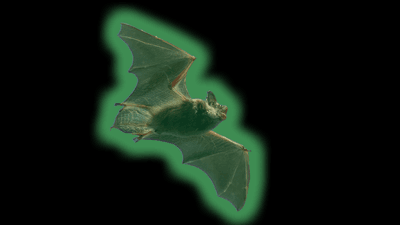


In a twist of fate that couldn't be more perfect for the Halloween season, researchers have discovered that six species of North American bats glow green under UV light.
Last year, scientists discovered that the Mexican free-tailed bats' toes twinkled a greenish-blue under UV light and it may be used as their own bat signal to communicate. Now, it's the bats of North America's turn to be revealed as glow-in-the-dark species – the first known winged mammals to emit an all-over body glow in this part of the world. However, scientists are not sure why they do.
“It may not seem like this has a whole lot of consequence, but we’re trying to understand why these animals glow,” said study co-author Steven Castleberry in a statement. “It’s cool, but we don’t know why it happens. What is the evolutionary or adaptive function? Does it actually serve a function for the bats?”
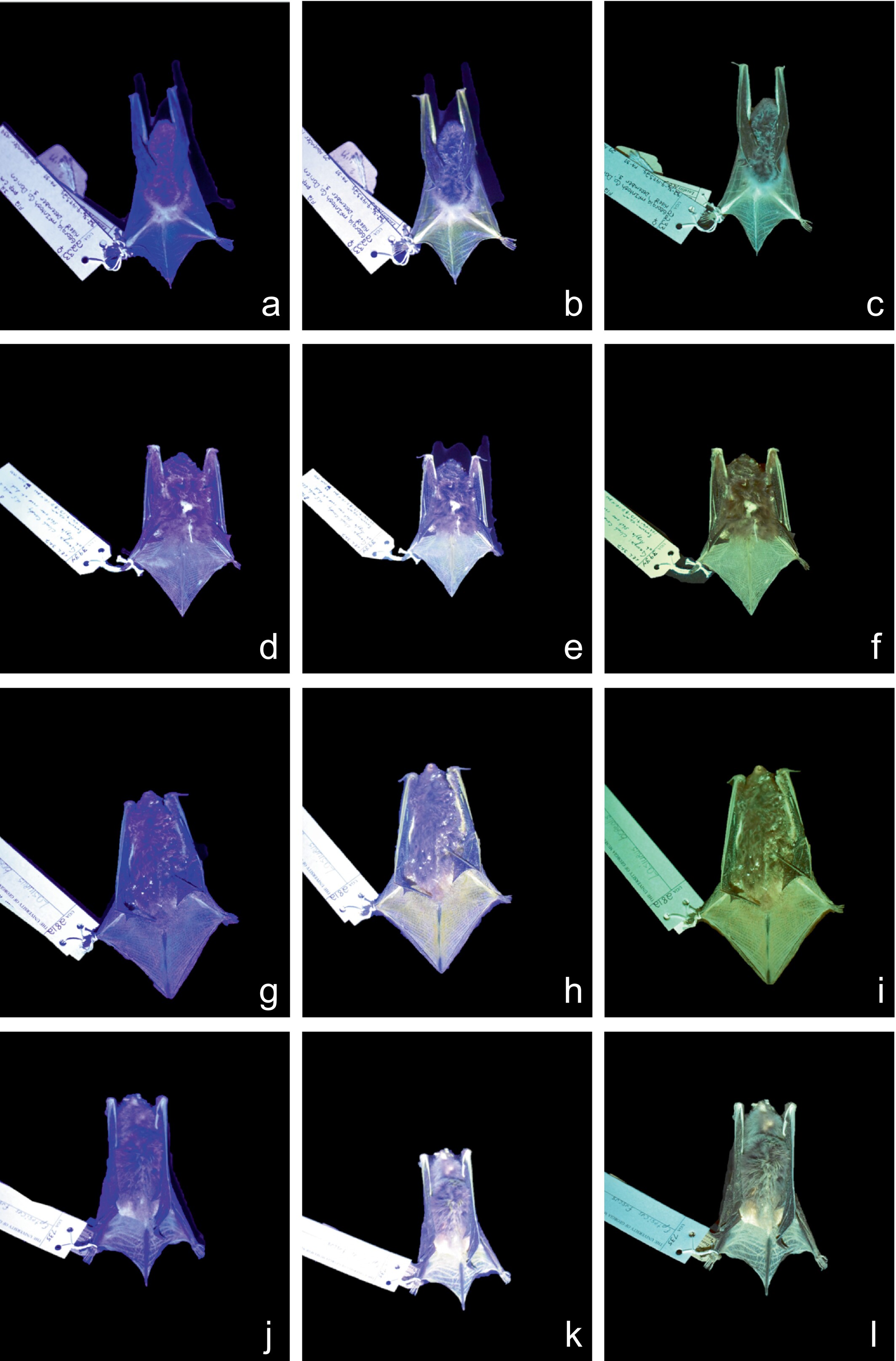
The six species looked at under UV light – big brown bats (Eptesicus fuscus), southeastern myotis (Myotis austroriparius), gray bats (Myotis grisescens), eastern red bats (Lasiurus borealis), Seminole bats (Lasiurus seminolus), and Brazilian free-tailed bats (Tadarida brasiliensis) – were from a collection at the Georgia Museum of Natural History, which had been collected between 22 and 103 years ago.
Interestingly, the team found that every single species and every single one of the 60 specimens they tested glowed when exposed to UV light. While the team found some differences in the intensity with which certain species glowed, they found that they all emitted a green hue. The team found no differences between sexes and no difference in wavelengths with the age of the specimens, either. The glow was seen on the hind limbs, wings, and the uropatagium, which is a membrane that stretches between the hind limbs.
The team was eager to explore why the bats might glow under UV light. Because there was no difference in the wavelengths emitted for each sex, they ruled out sexual selection as a driver for this trait.
Given that all the species glowed, the team wondered if there was a common trait shared between all the bats that could be a clue. However, the species have different social behavior, as well as roosting preferences. For example, species in the genus Myotis, T. brasilensis, and E. fuscus roost in caves and hollow trees, while species in the genus Lasiurus roost in foliage.
The team thought that the green glow could help the Lasiurus species blend into the canopy, but concluded that since it is largely similar across all six species, regardless of roosting site, “color of photoluminescence is not likely to be specifically niche-adapted for the roosting environment in these species.”
They do, however, think that the trait is genetic rather than adapted to the environment they live in.
"The data suggests that all these species of bats got it from a common ancestor. They didn't come about this independently," Castleberry said. "[M]aybe glowing served a function somewhere in the evolutionary past, and it doesn't anymore."
Whether it is also a form of communication like the Mexican bats will require more study. “Our results suggest a shared physiological origin, but we cannot confirm any shared behavioral function,” they conclude in the study.
These bats are far from alone in glowing under UV light and, in fact, join something of a party with long-eared owls, a host of Australian mammals, dormice, flying squirrels, and many more – including humans!
The study is published in Ecology and Evolution.