Nature
 PUBLISHED
 1
1


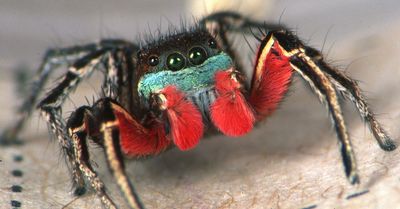


The jumping spider genus Habronattus consists of around 100 species that all diverged from each other within the last 2.5 million years. To breed, the males typically perform displays involving movement, vibrations, and ornamentation. Sometimes the males of these species will even perform successful mating displays to females of different species. By doing this, they've become a good model to study hybridization and how female choice plays a part in species diversification.
H. americanus have simple displays but impressive red coloration on their pedipals, legs, and chelicera. H. sansoni, on the other hand, is brown overall with two black stripes over the eyes and typically no red coloration. However, the hybridization of these two species had resulted in males with red coloration in H. sansoni. This leads to an idea called the “sea of red,” whereby other species are being slowly replaced by H. americanus due to female preference for red coloration and hybridization between species.
A team devised two experiments to test this: the first to see if females from both species would prefer the red males, and the second to manipulate the colors in each species to see if the color red was the driving force behind the mate choice regardless of species. Red H. americanus spiders typically perform shorter displays compared to the brown H. sansoni.
Initially, a female was placed in an arena, allowed to acclimate, and then a male was added to the same arena and allowed to interact for a maximum of 15 minutes. “We ended mating trials before 15 min when there was copulation or cannibalism,” explain the authors. The H. americanus males were preferred by females of both species. When females of H. sansoni are presented with a H. americanus male, they mate 74 percent of the time compared to just 31 percent with a male of their own species.
To make things more interesting, the team came up with a plan to change the colors of the spiders to see if the red color really was the deciding factor. The team painted the typically brown H. sansoni red, and the typically red H. americanus brown, as controls for each. The results from the trials show that the red H. sansoni males had a higher mating rate than the controls, but the mating rate of the brown H. americanus did not differ between red or brown males.
Overall, the team thinks that mate choice in H. americanus is based more on the visual cues like posture and performance rather than just the red coloration. But they do note that females do show preferences for red in H. sansoni males, and that could lead to hybridization.
The paper is published in Proceedings of the Royal Society B: Biological Sciences.