Nature
 PUBLISHED




Bad news, everyone: the ocean’s on fire — again.
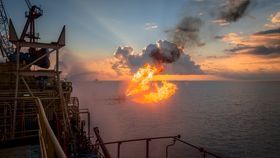
Over the weekend, a fire lit up the ocean's surface west of Mexico’s Yucatan peninsula after an underwater gas pipeline sprung a leak on Friday. Meanwhile, on the other side of the planet in the Caspian Sea, a gigantic fireball flared in the offshore oil and gas fields off Azerbaijan on Sunday, reportedly because of a violent mud volcano.
The fire in the Gulf of Mexico took palace in the Ku Maloob Zaap oil development, operated by Mexican state-owned company Pemex. As per Reuters, Pemex said the gas leak ignited about 5:15 am local time on Friday, July 2 and was extinguished by 10:30 am.
No injuries were reported and the incident rportedly did not spill any fossil fuels into the surrounding environment. An internal report, seen by Reuters, claims the accident was caused by an “electrical storm and heavy rains” disturbing the turbomachinery at the facility. Pemex also noted that the fire was controlled by spraying nitrogen onto it.
Sensational videos of the incident went viral on social media, showing a circular plain of water surreally burning bright orange on the sea surface with what some people mistook to be ships spraying water onto the fire that was already occuring in the water.
Some folks on Twitter used the shocking footage to highlight the dangers of fossil fuels and humanity’s fractured relationship with the natural environment.
"Meanwhile the people in power call themselves "climate leaders" as they open up new oilfields, pipelines and coal power plants — granting new oil licenses exploring future oil drilling sites," climate activist Greta Thunberg tweeted alongside the video.
"This is the world they are leaving for us."
Just two days later, another fiery outburst hit the Caspian Sea off the coast of Azerbaijan around 10 kilometers (6 miles) from the Umid gas field. The Associated Press reports that Azerbaijan's state-owned oil company SOCAR was not certain what caused the explosion, but preliminary information indicates it was a mud volcano.
Mud volcanoes are not actual volcanoes as they don’t produce lava. Instead, they typically shoot out a flurry of mud, hot water, and gas. If the mud volcano is close to active hydrocarbon systems, such as in Azerbaijan, they erupt oil and natural gas which ignite when lit.
Azerbaijan and its Caspian coastline are home to around 400 mud volcanoes, nearly a third of the world's mud volcanoes. Mark Tingay, a mud volcano expert and adjunct associate professor at the University of Adelaide in Australia, tweeted that the explosion “certainly could be a mud volcano” and may have sprung from a particular well-known mud volcano called Makarov Bank, which erupted just like this before in November 1958.



 1
1