


 Nature
 PUBLISHED





Earth’s climate has always been changing – but never like this. New research reveals that global temperature rises have accelerated at an unprecedented rate since 2015.
In the new study, a statistician and a climate scientist show that the world warmed at a rate of 0.35 °C (0.63 °F) per decade over the past 10 years, compared with just under 0.2 °C (0.36 °F) per decade on average from 1970 to 2015.
It's well-established that Earth’s global temperature has been steadily creeping up since the mid-19th century, when the Industrial Revolution ushered in a surge of carbon dioxide and other greenhouse gases. However, the latest analysis confirms that the recent rate of warming in the past 10 years has significantly outpaced any previous decade since reliable record-keeping began in the 1880s.
“We can now demonstrate a strong and statistically significant acceleration of global warming since around 2015,” Grant Foster, a US statistics expert and co-author of the study, said in a statement.
To reach their conclusions, the duo analyzed five major global temperature datasets – NASA, NOAA, HadCRUT, Berkeley Earth, and ERA5 – and each one showed a clear uptick in warming beginning around 2013 and 2014.
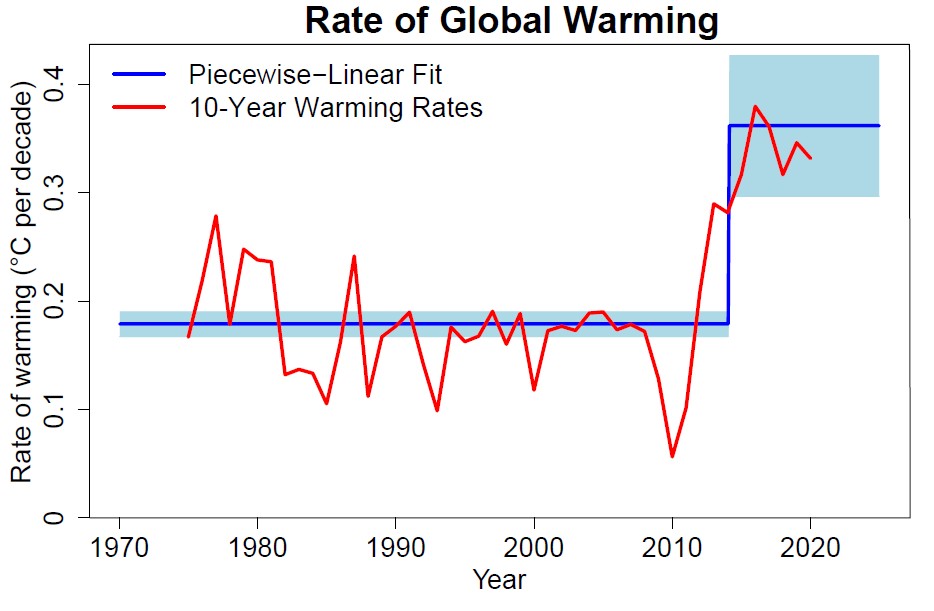
“The adjusted data show an acceleration of global warming since 2015 with a statistical certainty of over 98 percent, consistent across all data sets examined and independent of the analysis method chosen,” explained Stefan Rahmstorf, Potsdam Institute for Climate Impact Research (PIK) researcher and lead author of the study.
Importantly, they found that this recent uptick since 2015 was not explained by natural variation – the “get out of jail free card” that climate change skeptics often point to.
Both 2023 and 2024 were exceptionally warm years influenced by an El Niño event and the solar maximum, but those years remained marked by abnormal increases even once these natural factors were removed from the equation. Volcanic eruptions, another natural force that can suddenly alter the climate, similarly failed to explain the change.
“We filter out known natural influences in the observational data, so that the ‘noise’ is reduced, making the underlying long-term warming signal more clearly visible,” Foster added.
While the study did not investigate the specific causes of the acceleration, a wealth of evidence indicates that the continued increase in greenhouse gas emissions could fit the bill. Alternatively, or perhaps concurrently, we may have entered a phase where cooling aerosols are no longer masking the true extent of global warming.
Whatever the explanation, the latest study indicates that the world will struggle to keep within the bounds of international climate targets if this past decade signifies an ongoing trend.
“If the warming rate of the past 10 years continues, it would lead to a long-term exceedance of the 1.5 [°C] (2.7 [°F]) limit of the Paris agreement before 2030,” said Rahmstorf.
The study is published in the journal Geophysical Research Letters.



 1
1