Humans
 PUBLISHED




In Iron Man, Tony Stark – a bona fide genius physicist and engineer, we are told – creates the arc reactor, a source of essentially unlimited clean energy. And what does he do with this world-changing invention? Why, he keeps it for himself, of course – quite literally implanting the first iteration into his own body, and waging unilateral war on anybody who tries to replicate the device.
It’s real comic book villain type stuff, which is odd for a comic book hero, and it would sound totally unbelievable if not for the fact that it kind of already happened. At least, on a much lower-stakes scale.
If you ask, say, your high school history teacher who the inventor of the steam engine was, they’d likely point to two guys: Thomas Newcomen and James Watt. Both lived in Britain in the 18th century – that’s a huge part of the reason the Industrial Revolution began there – and both designed steam engines with grand ambitions in mind: pumping water out of coal mines; driving machinery in factories; transport, of course; that kind of thing.
That’s all true, but it’s not the whole story. Frankly, Newcomen and Watt were not only not the original inventors of the steam engine, but they’re so far down the chronological list that it’s honestly kind of silly. People had in fact been using steam as a way to create movement since 300 BCE, when Archytas designed a little bird toy that farted out hot air to fly along a wire.
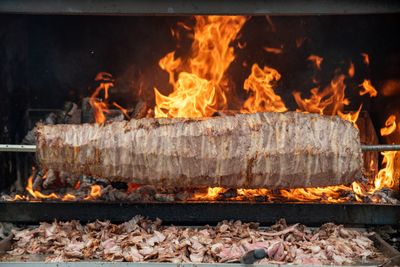
Now, you might think a flatulent pigeon is a rather frivolous use of steam engine technology – but as it turns out, a fair chunk of the pre-Industrial inventors of steam-powered movement were kinda silly little guys. And that’s where Taqi al-Din comes in: the man who one day saw a kebab being roasted on a spit, and thought, “there must be a cooler way to do that”.
Taqi al-Din: inventor of the steam-powered kebab
Taqi ad-Din Muhammad ibn Ma'ruf ash-Shami al-Asadi was born in 1526, and he spent his 60-ish years on Earth being a very busy man. He wrote more than 90 books in his life, covering topics as diverse as math, astronomy, optics, clocks, medicine, zoology, and more. He had his own astronomical observatory in Constantinople – at the time, one of the largest in the world, and often compared favorably to Tycho Brahe’s Uraniborg – and filled it with his own cutting-edge instruments, including high-accuracy clocks and tools to determine the equinoxes and eclipses.
But sometimes, his inventions took on a more playful bent. Not for nothing was the classical Arabic term for mechanics and engineering “Ilm al-Hiyal” (the “science of tricks”); in a 1551 treatise by Taqi, some two-fifths of the writing is devoted to the use of mechanical gizmos and gadgets for entertainment.
It’s that treatise, The Sublime Methods of Spiritual Machines – “spiritual” here should be read as “pneumatic”, a calque via the Greek works that were imported to the Islamic world during the Golden Age – where Taqi outlined the basic steam engine that made him a modern meme.
“Part Six: Making a spit which carries meat over fire so that it will rotate by itself without the power of an animal,” he wrote. “This was made by people in several ways, and one of these is to have at the end of the spit a wheel with vanes, and opposite the wheel place a hollow pitcher made of copper with a closed head and full of water.”
“Let the nozzle of the pitcher be opposite the vanes of the wheel. Kindle fire under the pitcher and steam will issue from its nozzle in a restricted form and it will turn the vane wheel,” he explained. “When the pitcher becomes empty of water bring close to it cold water in a basin and let the nozzle of the pitcher dip into the cold water. The heat will cause all the water in the basin to be attracted into the pitcher and the [the steam] will start rotating the vane wheel again.”
There’s no denying it: That’s a steam engine, very similar in concept to the one developed by Thomas Newcomen some 160 years later. So, here’s a question: Why didn’t the Industrial Revolution start in 16th-century Constantinople, powered by kebabs?
Right idea, wrong time
“Historians of technology have long noted that inventions are not ideas so much as they are systems,” wrote Alex Wellerstein, a historian of science and nuclear technology at the Stevens Institute of Technology, back in 2018.
“[That] is to say, they are not one person saying, ‘hey, wouldn't it be neat if we could fly in a helicopter?’,” he explained. “Instead, they are what we sometimes pretentiously call assemblages: the intersection of ideas (often many of them), social circumstances, resources, and institutions of one sort or another.”
As ingenious as the machine Taqi described may have been, it was simply the wrong time for it to be invented. It was too early for the kinds of technology and techniques needed to scale up the design or make the engine efficient enough for more heavy-duty uses, such as those seen in the Industrial Revolution.
In fact, as much as he may be the one who has become internet famous, Taqi wasn’t even the only person of his era using steam engines just to help make dinner. Giovanni Branca, an Italian engineer from Sant'Angelo in Lizzola, presented a similar steam-powered machine in his 1629 work Le Machine; it could, he suggested, be used for powering pestles and mortars or sawing wood – not much of an improvement on Taqi’s applications, and likely even less useful than that Ancient Greek birdie.
John Wilkins, one of the founders of the Royal Society and very early space colonist – he was famous in his own time for claiming that “it is probable there may be another habitable world in the moon,” which made him about as much of a laughingstock as you’d imagine – also had both grand and humble ideas for the potential of steam engines. While he proposed (correctly, as it turned out) that they could be used to create flying machines, the contraptions he actually described included a smokejack that was used to – you guessed it – turn a spit.
None of these are bad or foolish applications of the technology, even if they may seem frivolous to us today. People need to eat, after all, and the constraints of the time meant that steam power couldn’t be used for much more in any case. What inventors like Taqi, Branca, Wilkins, and even Leonardo da Vinci lacked – and what Newcomen and, to an even greater extent, Watt benefited from – was not vision, but an enormous amount of support in the forms of previous work and financial investment.
“Could Taqi al-Din have come up with a working steam engine? Maybe. But it's not as easy as just deciding to make it,” Wellerstein wrote. “Thomas Newcomen's success was not that he was smarter than any of those [previous inventors]; he ended up being persistent, in part because there was a huge, obvious financial goal at the time (pumping water out of coal mines).”
“If it hadn't been harnessed to the economic needs, would [Newcomen’s engine] have taken off?” he mused. “Who knows, but probably not.”