Nature
 PUBLISHED


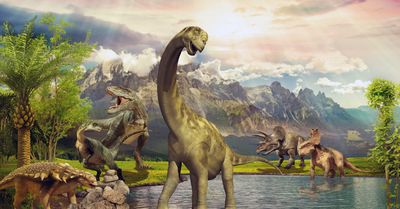


The diversity of early dinosaur fossils and the rate at which they evolved suggests the original dinosaur long predated the earliest specimens we have found. A new study takes a rigorous approach to this question and estimates that “dinosaurs emerged between 250 and 240 [million years ago], at least 10 million years before the earliest unambiguous dinosaur fossils.”
Defining exactly when one species evolved from another is arguably an unsolvable problem, since evolution takes place so gradually. It’s even more difficult to be definitive when it comes to a collection of species. When all we have are a few bones, rather than complete skeletons, there’s no way to say which was the first true dinosaur. Nevertheless, getting an answer precise to a million years or so is a matter of considerable interest.
Fossils generally agreed to be true dinosaurs have been found from 230-233 million years ago, with others generally relegated to the status of dinosaur predecessors. However, those first dinosaur fossils are not from a single species, or even from a closely related genus, but multiple branches of the family. Therefore, the common ancestor of dinosaurs must have been older, with time for their progeny to start the paths that led to the astonishing diversity of their heyday.
Yale PhD candidate Chase Brownstein and Dr Christopher Griffin of Princeton University used Bayesian tip-dated phylogenetic analyses to measure the diversity of those early fossils, looking at bone shape and size, and whether or not they had features such as horns. If the rate of subsequent diversification is extrapolated backwards, the first dinosaurs should have appeared between 240 and 250 million years ago.
This sort of analysis can never offer the certainty of digging up some bones with clearly dinosaurian traits. However, Brownstein and Griffin describe, “using multiple morphological matrices with different character and taxon sampling.” The consistency of the result using the four great branches of dinosaurs (sauropods, theropods, ornithischians and herrerasaurs), as well as when distinguishing the controversial silesaurid clade from the ornithischians, gives the authors confidence in their conclusion.
Ornithischian dinosaurs did diversify more rapidly in the early Jurassic than the other lineages, demonstrating the benefits of combining evidence from as many families as possible.
"The patterns that we infer are consistent with the expectations under a scenario of evolutionary radiation, in which ecologically disparate lineages rapidly diversify from a single common ancestor," the pair write.
The obvious response to work like this is: “But where are the fossils?”. It’s always possible the answer is that there aren’t any because for most of that time the early dinosaurs were living in places not suited to preserving a record, or where we haven’t looked yet. Until about 234 million years ago Pangea had arid bands that might have kept the early dinosaurs constrained to a relatively limited southern range, after which the climate got drastically wetter.
However, Brownstein and Griffin note that we may in fact have fossils, albeit not bones. Footprints have been found from around 250 million years ago made either by dinosaurs, or a close relative.
Brownstein and Griffin admit, however, that they do not know what caused dinosaurs to evolve, and then split into their major lineages within 5 million years. They note that many of the explanations offered for their appearance don’t fit well with the timing they propose.
The study is published open access in The Royal Society Proceedings B: Biological Sciences.
[H/T: Phys.org]