Nature
 PUBLISHED


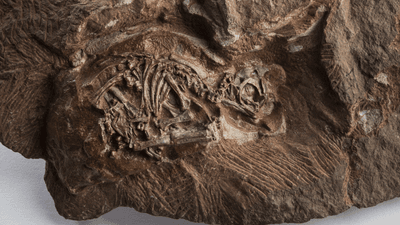


Imagine this: you’ve found yourself a lovely dinosaur egg complete with preserved embryo inside. Better yet, it’s seriously old – around 190 million years, in fact – representing one of the oldest dinosaur embryos known to science. Only problem is, how do you look inside without destroying it?
A 2020 study set out to find out how old some of the oldest dinosaur embryos known to science were when they died. Along the way, it introduced a new quantitative method to estimate how far dinosaur embryos had developed without cracking them open. It involved reconstructing their tiny skulls in 3D revealing minute details, some of which had never been seen in dinosaurs before.
A clutch of seven fossilized Massospondylus carinatus eggs journeyed to the particle accelerator at the European Synchrotron Radiation Facility (ESRF) in Grenoble, France – quite the trip for a few baby dinosaurs that never even made it out of the egg. Here, an 844-meter-long (2,769-foot-long) ring of electrons was accelerated close to the speed of light, making them emit high-powered X-ray beams that scanned the fossils at an unrivaled level of microscopic detail. This technique is known as synchrotron X-ray imaging, and it comes with many perks.
"A synchrotron has several advantages over a laboratory CT scanner," Kimberley Chapelle, PhD, study author and vertebrate paleontologist then based at the University of the Witwatersrand in South Africa, told IFLScience. "For example, a synchrotron source is one hundred billion times brighter than a hospital X-ray source.”
“Secondly, properties of the synchrotron radiation also make it thousands of times more sensitive to density contrast, meaning that it makes it much easier to differentiate bones from the encasing rock matrix."
Only three of the seven eggs were found to contain embryonic bone, and as for the big question: how old were the ill-fated babies? They compared the embryos to those of chickens, crocodiles, tortoises, and lizards, paying close attention to which skull bones had begun to ossify, and how developed they were. This enabled them to establish that the baby dinosaurs were just 60 percent of the way through their incubation when they died. Not even close to hatching.
The specificity of the scans was unprecedented at a resolution of just a few microns, fine enough to capture extremely thin embryonic bones. It’s hardly surprising, then, that the resulting 3D reconstructions revealed traits the scientists hadn’t expected.
"I was really surprised to find that these embryos not only had teeth, but had two types of teeth,” said Chapelle said in a statement. “The teeth are so tiny; they range from 0.4 to 0.7 mm wide. That's smaller than the tip of a toothpick!"
These are thought to be null-generation teeth that appear temporarily in some living reptile embryos – a trait that had never before been reported in dinosaurs. It further supports the indication that the trio of eggs were a long way off hatching at the time of their deaths.
While a sizable piece of kit is needed, the study was proof of concept that we can figure out how old dinosaur egg embryos are without breaking them apart. That said, if you’d like to take a peek inside a dinosaur egg that has been cracked open, check out this near-complete specimen nicknamed Baby Yingliang.