Nature
 PUBLISHED



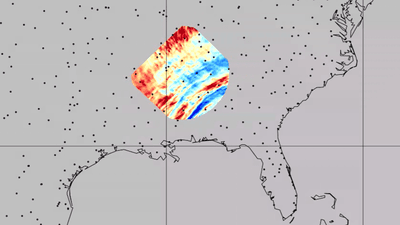


Hurricane Helene made landfall in the United States on September 26, hitting the Gulf Coast of Florida. Its path of death and destruction was monitored in detail from the ground and space, and it was even spotted by an instrument located on the International Space Station. As the ISS flew over it, the Atmospheric Waves Experiment (AWE) saw how the hurricane was shaking the atmosphere far above the storm.
These shakes are known as gravity waves – which are not related to gravitational waves. The latter are formed by the literal rattle of space-time and you need huge detectors to measure them. Gravity waves instead form at the interface of two fluids or between two regions of the atmosphere with different properties. Waves on the surface of the sea are an example of gravity waves.
Hurricane Helene slammed not just the land but the atmosphere too. The energy and heat coming from the large tropical storm created huge swells recorded at an altitude of almost 90 kilometers (55 miles), just shy of the conventional edge of space. Hurricanes tend to be about one-sixth of that height.
“Like rings of water spreading from a drop in a pond, circular waves from Helene are seen billowing westward from Florida’s northwest coast,” Ludger Scherliess, the AWE principal investigator at Utah State University in Logan, said in a statement.
While seeing waves in the sea is very clear to our eyes, in the atmosphere, these gravity waves are invisible to us. Satellites, however, can measure them, and in several ways. For example, satellites that track water vapor can spot them because the quantity will change if you are within the peaks or the valleys formed by the passing of these waves.
AWE focuses on colorful bands of light known as airglow to measure the waves in the upper atmosphere. This is important to understand the interactions between space weather and the layers of air that surround our planet.
Gravity waves in the atmosphere are a common phenomenon. NASA released a beautiful image of waves forming around an island two years ago, for example. They are also not exclusively an Earthly phenomenon. They have been seen in the tenuous envelope of Pluto, the dense atmosphere of Venus, and even on Jupiter just above its Big Red Spot.

 1
1