Nature
 PUBLISHED
 28
28


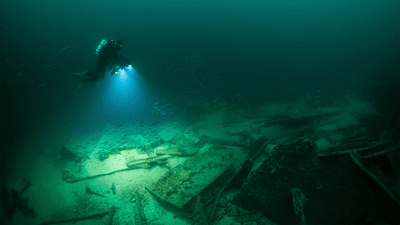


In 2001, a team of researchers began using sonar equipment to map the ocean floor off the coast of Cuba, as part of a project to explore underwater shipwrecks in the area. Hundreds of ships from the Spanish colonial era are believed to lie at the bottom of the ocean there, many potentially filled with ancient treasure. But as they were conducting this work, the team – from Canada – noticed a few unusual features at the bottom of the ocean.
It wasn't shipwrecks, but a surprisingly symmetric and geometrically organized set of stone structures, which they believed to resemble an ancient urban complex, 600 meters (2,000 feet) under the sea.
Returning to the site the following year with an underwater drone, the team found giant, smooth blocks of rock that looked like cut granite, some of which were circular, and some resembling pyramid structures.
The team, from the company Advanced Digital Communications, got pretty excited about their find.
"The structures we found on the side scan sonar simply are not explicable from a geological point of view," Paul Weinzweig, one of the team, told the South Florida Sun-Sentinel in 2002. "There is too much organization, too much symmetry, too much repetition of form."
Needless to say, this find prompted plenty of "ancient Atlantis" speculation in those sorts of circles.
According to Weinzweig, the structures were likely around 6,000 years old, pre-dating the pyramids. That would be an astonishing find, but as Carl Sagan once said, extraordinary claims require extraordinary evidence, and here the evidence is certainly lacking. Others were far more skeptical.
"It would be very cool if they were right," Michael Faught, specialist in underwater archaeology at Florida State University, added to the South Florida Sun-Sentinel. "But it would be real advanced for anything we would see in the New World for that time frame. The structures are out of time and out of place."
"It's a really wonderful structure which really looks like it could have been a large urban centre," ADC explorer Paulina Zelitsky added to Reuters, per BBC News. "However, it would be totally irresponsible to say what it was before we have evidence."
It would also take some explaining how a 6,000-year-old site like this could sink to the ocean floor. Manuel Iturrald, geologist at Havana's National Museum of Natural History, explained that at the maximum pace of tectonic movement, it would take at least 50,000 years for such a site to fall that low in the sea. Meanwhile, nature can sometimes present us with structures that look ordered and structured, but are made through natural processes.
There hasn't been much in the way of follow-up at the site, largely due to the extreme depth of the site, and financial constraints. Without further evidence, it is best to assume that the site is like other underwater natural formations, which happen to look a bit like they were shaped by humans, but certainly are not.