Nature
 PUBLISHED
 9
9


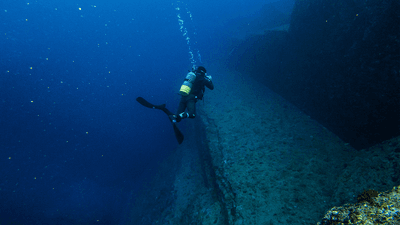


In 1986, diver Kihachiro Aratake was searching off the coast of Yonaguni, one of the westernmost islands of Japan, for areas to take tourists to when he spotted some unusual underwater structures on the ocean floor.
Aratake, director of a local tourism association, saw the features around 25 meters (82 feet) below the surface. Arranged in front of him was a rectangular and pyramid-like rock structure, with the appearance of having steps cut into it.
"Roughly 35 years ago, while I was out searching for a diving point, I stumbled on it by pure coincidence," Aratake told the BBC in 2022. "I was very emotional when I found it. Upon discovering it, I realized that this would become a treasure of Yonaguni Island."
Aratake believed that the structure, now known as the Yonaguni Monument, may have been made by ancient humans, and contacted scientists at the University of the Ryūkyūs for further investigation. Perhaps unsurprisingly, the find drew some odder hypotheses about its formation.
Masaaki Kimura, a marine biologist at Ryūkyūs, suggested in his book Mu Tairiku Wa Ryukyu ni Atta (The Continent of Mu was in Ryukyu, 1997) that the area was in fact the lost continent of Mu, an alternative name for the hypothetical continent Lemuria, proposed in 1864 to explain why lemur fossils are found on Madagascar and the Indian subcontinent, but not continental Africa or the Middle East. According to that idea, which was rendered obsolete when we discovered plate tectonics, Madagascar and India were part of a larger continent, which then sank to the bottom of the ocean.
Others have suggested that the structure could have been made 10,000-14,000 years ago, placing it potentially before any known civilization capable of creating such a monument. And of course it's been linked to Atlantis.
As fun as that would be, when the claims are big, you need big evidence; otherwise, it's usually a sign to be even more skeptical. What we are likely looking at here are some interesting rocks. Nature, despite claims to the contrary, does throw up some interesting features and structures that look too geometrically perfect to be natural, like the hexagonal columns of Ireland's Giant's Causeway on Earth or Saturn's polar hexagon. Here too, nature can provide an explanation without the need to invoke ancient lost civilizations.
"I'm not convinced that any of the major features or structures are manmade steps or terraces, but that they're all natural," Robert Schoch, professor of science and mathematics at Boston University, who conducted dives at the site, told National Geographic.
"It's basic geology and classic stratigraphy for sandstones, which tend to break along planes and give you these very straight edges, particularly in an area with lots of faults and tectonic activity."
Schoch himself is no stranger to fringe science, being best known for the widely rejected hypothesis that the Sphinx is far older than we think, but to him, the Yonaguni Monument formation looked natural.
"The more I compared the natural, but highly regular, weathering and erosional features observed on the modern coast of the island with the structural characteristics of the Yonaguni Monument, the more I became convinced that the Yonaguni Monument is primarily the result of natural geological and geomorphological processes at work," he says on his website.
"On the surface, I also found depressions and cavities forming naturally that look exactly like the supposed "post holes" that some researchers have noticed on the underwater Yonaguni Monument."
The consensus is that the Yonaguni Monument is, in fact, a natural formation. But with plenty of sharks in the area, and the monument itself being a pretty strange sight, it still draws in a lot of tourists. Even if it isn't the sunken remains of Japan's Atlantis, it's still a very cool area of the world.