Nature
 PUBLISHED


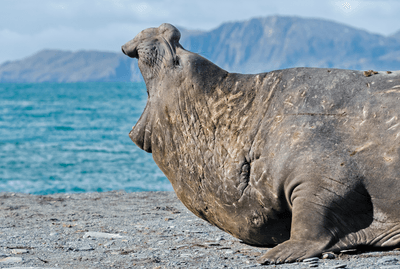


Over time, there seems to be an irresistible pull for animals to get bigger and bigger. Ancient horse ancestors were the size of a terrier, and the first whales were wolf-sized waders. Even the great elephant started as a Moo Deng-sized miniature. Our Stone Age relatives, too, were significantly smaller in stature.
This observation – that animal lineages evolve toward larger body sizes – is known as Cope's rule. It’s most prominently seen in mammals, although scientists have argued it can also be seen in other realms of life. For instance, a 2015 study of marine animals over 542 million years found a clear overall trend toward larger body sizes across the fossil record.
Named after American palaeontologist Edward Drinker Cope, the hypothesis hints that natural selection can favor larger animals as they are better at dominating competitors, warding off predators, and attracting mates.
However, Cope's rule doesn't mean large bodies are inherently superior; it's more that most animal groups tend to start out small relative to their eventual optimum. In a sense, the only way is up.
More recent studies have both confirmed and complicated Cope's rule. While large bodies do hold some advantages, they also bring new burdens. Big animals need more food, reproduce more slowly, and maintain smaller populations. When disaster strikes, like a rapidly changing climate, it's generally the giants that go down first. Just look at the dinosaurs. When the asteroid struck on that fateful day 66 million years ago, Tyrannosaurus and Triceratops were quick to go, while the scrappier mammals were the ones that made it through the turmoil.
And although giant species may dominate their era, their highly specialized bodies make them evolutionary dead ends, unlikely to give rise to entirely new groups of animals. Large animals are so finely tuned to their particular niche that there is little room left to adapt, while smaller animals can be more flexible and pave the way for evolution's next chapter. In other words, ecosystems can become filled with large creatures that hang around until a wave of extinction knocks them out and vacates the niche.
It’s also evident that there are natural limits of size; animal lineages do not simply grow and grow indefinitely. The square-cube law explains why; as animals get bigger, their volume grows much faster than their surface area. This means legs, bones, and hearts must work exponentially harder to support the extra mass. Eventually, the bioengineering simply doesn't hold up. This is why the world will (hopefully) never see a city-smashing monster the size of Godzilla.
In more recent years, many biologists have contended that Cope’s rule isn’t some objective law deeply embedded in the code of reality, but a statistical artefact born out of bias. Some research has suggested that lineages showing an increase in size are no more common than those showing a decrease. Our tendency to see Cope’s rule in nature may simply reflect our bent to study larger and more charismatic animals, skewing our perception of the natural world and the ubiquity of bigger beasts.
There are plenty of exceptions to Cope's rule, too. Island dwarfism describes how species miniaturize when resources are scarce within a limited geographic range, like a small tropical island. The effect has famously produced some remarkable results, from dwarf elephants and mini hippos to the hobbit-sized human relative Homo floresiensis.
Ultimately, what matters in evolution is not how big you are, but how well you fit your moment. Size may open doors in certain scenarios, but adaptability is what keeps a lineage off the extinction list.

 1
1