Nature
 PUBLISHED





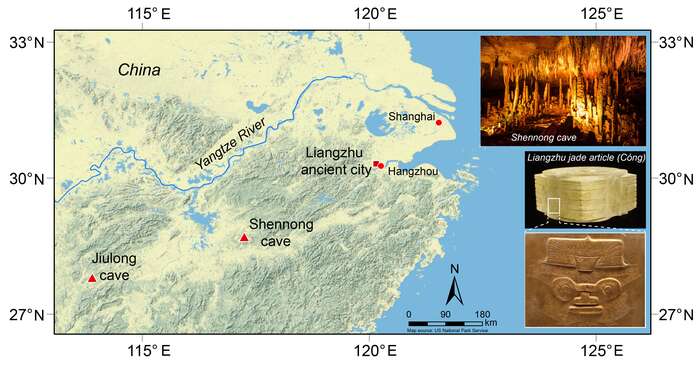
The city of Liangzhu in China's Yangtze Delta achieved technological advancement 5,300 years ago possibly unique in the world of the time. Its system of canals and dams has led to it being called “China's Venice of the Stone Age”, but after almost a thousand years, the city and its civilization collapsed, apparently quite suddenly. The cause has been debated, but new research pins the blame on temporary climate changes that caused flooding beyond the capacity of even such an advanced water management system to control.
At a time when most of the world had yet to discover agriculture, Liangzhu was pioneering hydraulic engineering. Although walled to keep out invaders, what really distinguished the city, and must have been a marvel to any visitors, were waterways that allowed the cultivation of large areas of the fertile, but naturally water-logged, delta.
The building of such an ancient wonder by people who had yet to discover metallurgy is a marvel, but Professor Christoph Spötl of the University of Innsbruck is most interested in why a city that stood for so long finally fell. In Science Advances, Spötl and co-authors match the timing with changes in the strength of the Asian monsoon.
"A thin layer of clay was found on the preserved ruins, which points to a possible connection between the demise of the advanced civilization and floods of the Yangtze River or floods from the East China Sea. No evidence could be found for human causes such as warlike conflicts," Spötl, said in a statement. "However, no clear conclusions on the cause were possible from the mud layer itself."
To test if floods were the problem, the team investigated the climate higher up in the Yangtze River Valley over the last 100,000 years using stalagmites from the Shennong and Jiulong caves. The rate of precipitation of limestone in the caves gives a loose indication of rainfall at the time, but carbon isotope analysis provides far more precision.
Between 4,345 and 4,324 years ago the Valley experienced a major increase in rainfall. The timing matches that of Liangzhu's fall to within the study's margin for error.

"The massive monsoon rains probably led to such severe flooding of the Yangtze and its branches that even the sophisticated dams and canals could no longer withstand these masses of water, destroying Liangzhu City and forcing people to flee," Spötl said.
Perhaps if things had quickly returned to normal, survivors would have reclaimed the city, but the caves record subsequent bouts of very wet weather over the next 300 years. These occurrences were probably too frequent to make restoring the city viable in that time. By the time the climate returned to that of Liangzhu's glory days, it would have been a legend at best to the descendants of those who once lived there.
The cave record shows other climatic shifts also coincided with changes in Chinese civilization, particularly when a megadrought around 4,000 years ago was accompanied by the founding of the first dynasty. The timing of the drought may have helped the emperor, Yu the Great, control the flooding that had hindered development for 300 years.