


 Nature
 PUBLISHED


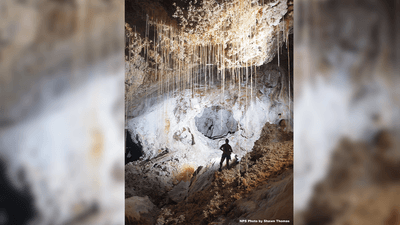


The vast Chihuahuan Desert, spanning across parts of Arizona, New Mexico, and Texas in the US, and Chihuahua, Coahuila, Durango, Zacatecas, and Nuevo León in Mexico, is a place of unique beauty. Cut off from the surrounding ecosystems around 9,000 years ago by mountains, it sits in a rain shadow that forced the life within to specialize to hyper-arid conditions – resulting in one of the most diverse and ecologically rich arid regions in the world.
But underneath it all, there’s something equally as fascinating: the Carlsbad Caverns National Park. Around half a million people each year visit this network of around 120 underground caves, formed through millions of years of slow erosion of the limestone rocks by sulfuric acid from the oil and gas deposits that sit even deeper within the Earth.
And who can blame them? The caverns are home to stunning beauty at record-beating size and scale, explosive bat poop, and – if you know where to look – perhaps the secret to extra-terrestrial life.
Carlsbad Caverns' Big Room
In the cavern that gives Carlsbad Caverns National Park its name, there’s a big room. A really big room. A room so big that it could house four New York City blocks with wiggle room to spare. It’s a place the actor and comedian Will Rogers once called “the Grand Canyon with a roof over it” – and not just because of the views.
“The Big Room […] is the largest single cave chamber by volume in North America,” notes the National Park Service (NPS) – and, yes, as you may have guessed by now, “The Big Room” is literally this chamber’s government name. It’s well-earned: at more than 3.3 hectares (8.2 acres), it’s more than six times the area of an American football field and nearly five times that of a FIFA standard football pitch.
Despite this mega size, though, “the Carlsbad cavern is very easily accessible,” Lars Behrendt, a microbial biologist at Uppsala University, told BBC Future. “It's a very large limestone cave that tourists can visit that has steps and ladders and everyone can go down,” even those in wheelchairs, he said.
Those who do visit the cavern will find themselves surrounded by some of the most diverse and beautiful rock formations in the world: “Carlsbad Caverns and Lechuguilla Cave are well known for their great natural beauty, exceptional geologic features, and unique reef and rock formations,” reports UNESCO, which recognized the caverns as a World Heritage Site in 1995.
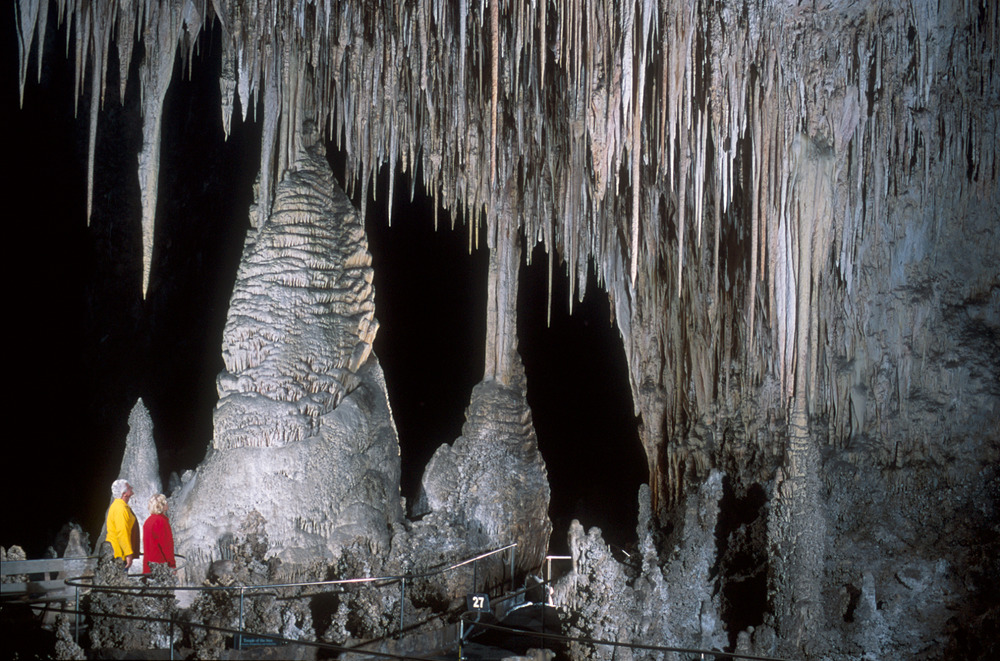
The reason for these formations, technically known as speleothems, is as unique as the cavern itself. Unlike most other caves – like, for example, those underneath Quintana Roo in Mexico – the Carlsbad Caverns were formed not by carbonic acid seeping down into the ground, but by sulfuric acid rising up. You can see the evidence for that even today: the floor of the Big Room is lined with huge gypsum blocks, byproducts of the “sulfuric acid bath” that created the cavern so many eons ago.
Eventually, so much of the ground was eaten away that the roof collapsed, opening the cavern to the terrestrial world. Suddenly, air could enter the area; snow and rain could make its way in – and with these above-ground invaders came the beginnings of what are now gigantic and iconic stalactites and stalagmites.
“The speleothems in Carlsbad Caverns are due to rain and snowmelt soaking through limestone, and the water absorbing gasses and minerals from the limestone,” explains the US Geological Survey (USGS). “When this water evaporates and emits carbon dioxide, calcite remains and slowly builds up over time. Stalactites form on the ceiling, while water that falls to the floor deposits minerals, creating stalagmites.”
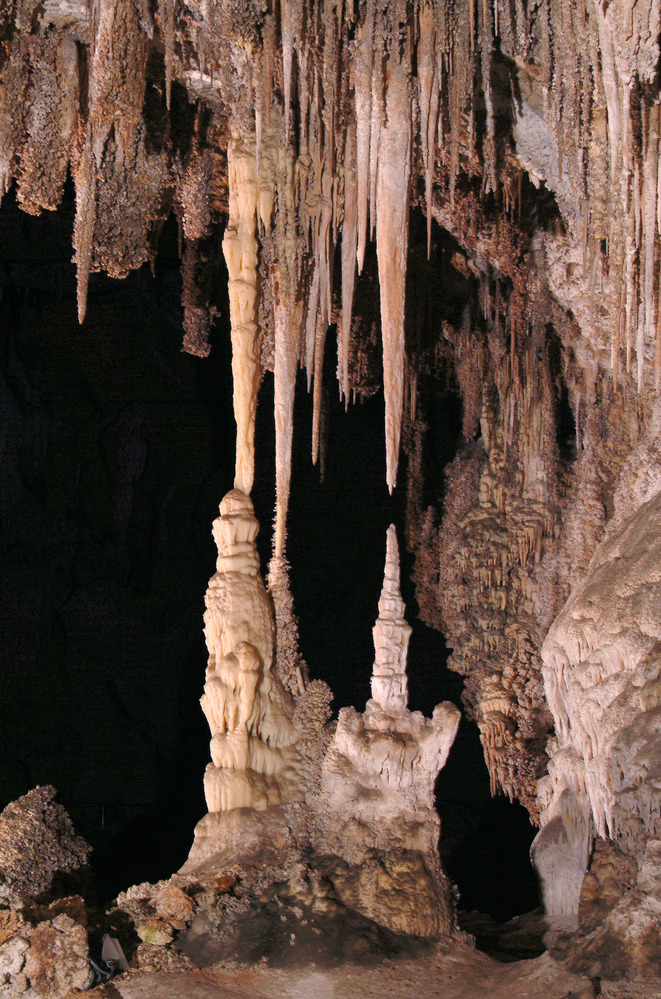
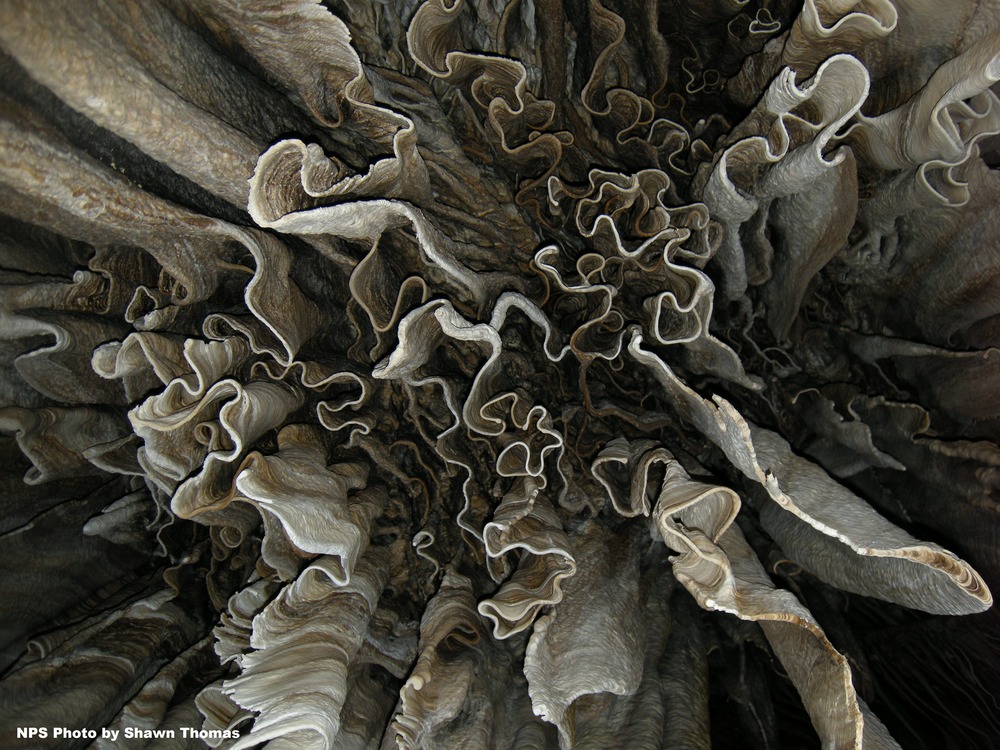
“There are several other types of speleothems found within Carlsbad Caverns National Park,” the USGS says, “including columns, soda straws, draperies, helictites, and popcorn.”
Subterrestrial extraterrestrial
Carlsbad Caverns may be millions of years old, but it’s by no means stuck in the past. In fact, there are parts of it where researchers are finding things they never thought possible – and which might have important ramifications for the search for alien life.
“The first thing you do in the Carlsbad cave is you kind of go down on the tourist trail, and then you turn around a corner,” Hazel Barton, professor of geological sciences at the University of Alabama, told BBC Future. “At that point, you go around the corner, and then behind you there's an alcove, and it's completely black.”
With no sunlight, photosynthesis should be impossible. And yet, in the pitch darkness, “the wall was bright green,” Barton said. “It was the most iridescent green you'd ever seen.”
Tests revealed that the green color came from cyanobacteria: bacteria that photosynthesize like plants, using sunlight to create energy and oxygen. But deep underground, these cyanobacteria were relying on something else for fuel: near-infrared light.
With its long wavelength, near-infrared light is hardy enough to survive the limestone surroundings in the cavern: “The limestone rock that the cave is made of will absorb almost all visible light, but to near-infrared light, caves are pretty much a hall of mirrors,” said Barton.
It’s invisible to humans, but chlorophyll d and f – the particular type of chlorophyll found in the cyanobacteria inside Carlsbad Caverns but not in plants or other cyanobacteria – pick it up readily. “Not only do [the cyanobacteria] live down there, but […] they photosynthesize in a completely sheltered environment where they've probably been untouched for 49 million years,” Behrendt said.
Now, that’s all very interesting, you might think, but why should we care? Well, confirmation that life can exist without visible light, surviving only on near-infrared, means something important about the hunt for alien life – namely, that it could exist in far more places than we previously assumed.
“The vast majority of stars in our galaxy are these M- and K-type stars,” Barton explained. “This means most of the stars in our galaxy are putting out near-infrared light.”
The majority of rocky planets found so far, too, are orbiting red dwarfs – M-type stars. And we don’t really yet know how, or even if, photosynthesis or life could survive under the light of a star like that.
But with the discovery of chlorophyll d and f being able to photosynthesize light with frequencies much lower than the visible spectrum, it means that the “Goldilocks zone” of habitability around red dwarfs might be wider than previously thought. And Barton and Bernhardt plan to do exactly that: go into the deepest, darkest caverns, and find cyanobacteria that can survive on the longest wavelengths possible – then use that information to direct JWST at planets that may have so far gone unexamined, and search for life.
If NASA gives the go-ahead, then, it’ll be a new era of scientific discovery in the Carlsbad Caverns. Not just for geologists anymore: soon, perhaps, this subterranean cave will be the vanguard for those searching for life among the stars.

 1
1