Technology
 PUBLISHED



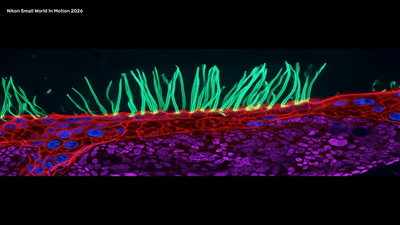


After much controversy, the winner of the Nikon Small World’s 2026 Small World in Motion has been officially disqualified after it was deemed that the video broke its rules on generative AI.
Nikon’s Small World in Motion is an annual competition that looks to find the most pioneering and most beautiful moving images captured through a microscope.
This year, the winner was Dr Ning Xu, from Tsinghua University in China, for his video purporting to show the abnormal movement of cilia (tiny, hair-like structures) in the airways of a child with primary ciliary dyskinesia (PCD), a rare genetic disorder that affects the respiratory system.
Scientists smell something fishy
However, some sharp-eyed scientists noticed that something was fishy with the video, and it was later revealed that Dr Xu had used an “unsupervised neural-network method” to enhance certain aspects of the imagery.
In an open letter to Nikon Small World in Motion, a collective of clinicians and researchers who diagnose and study PCD explained how the video could misrepresent what the disease looks like to the public, calling on the competition organizers to make it explicitly clear the winning imagery contains AI-generated content.
They stress that AI, if used appropriately, could be a powerful tool in medicine, but this awkward incident shows the perils of using AI in science without proper oversight.
“PCD is diagnosed partly by watching how cilia move, and ciliary structure can look normal even when motion is abnormal. This video misrepresents PCD in three ways: how affected cilia move, how airway cells and their cilia look, and how clearly current microscopy can capture ciliary motion,” the researchers write.
“Presented as footage of a child's rare disease and carrying the prestigious Nikon's award, this video has an authority that its content does not justify. We are also concerned that this video now will define what ‘PCD looks like’ for the public and for researchers and clinicians unfamiliar with the disease, and it may sit at the top of search results for PCD for a long time to come.”
“Every time it is shared, patients, families, charities, clinicians and scientists will have to work to correct the impression it leaves,” they added.
Their letter was signed by 463 researchers, microscopists, clinicians, patients, and advocates of the disease from 36 countries and territories, including three former Nikon Small World judges.
They also pointed out that the rules to the Nikon Small World competition clearly state: “AI generated videos are not permitted and Sponsor holds the right to request the original video for verification.”
The latest update from Nikon Small World
And so Nikon Small World decided to take action. On October 9, they released an update explaining why the winning entry had been disqualified, over three weeks after they swooped the top spot.
To fill the void, they shifted the top 5 winners up a place, with Nguyen Nam Nhat now winning first place for their video of a roundworm and a single-celled organism wiggling around.
“After thoroughly re-evaluating the video and supporting materials and consulting with members of our judging panel, Nikon has determined that the winning video did not comply with the competition rules regarding generative AI. Nikon has adjusted the competition rankings to reflect this decision,” Nikon Small World said in a statement.
“This decision is based solely on the submitted video's eligibility under the rules outlined for this competition. It should not be interpreted as a judgment of the entrant's professional reputation, scientific contributions, or intent.”
“Advances in imaging and artificial intelligence continue to evolve rapidly, creating new challenges for organizations across many fields. This event has shown the need for Nikon Small World and Nikon Small World in Motion to revisit rules and evaluation procedures for future competition entries,” they added.
The winners of the Nikon Small World Photomicrography Competition are set to be announced later in October 2026, no doubt after some particularly vigilant judging.