Technology
 PUBLISHED


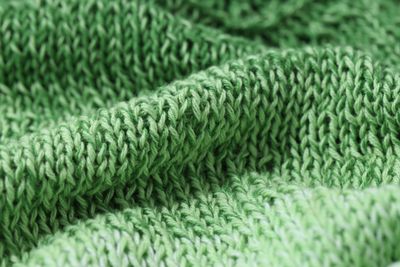


When you’ve had a big lunch and put on your stretchy pants, you might be thankful for the elasticity of the fabric to accommodate your additional girth.
But it is not just the stretchability of the material itself that can make a difference. It can also come down to the weave of the fabric.
A team of researchers in Japan have been using mathematics to look at the properties of how the yarns in fabrics are arranged and entangled to see how the specific characteristics of a material can be adapted through changing these arrangements.
How to test mathematical fabrics
“In knot theory, the mathematical study of tangled curves, the topology of a knot describes the arrangement of crossings that cannot be undone without cutting the curves,” the authors write in their paper. “Fabricating a textile involves entangling yarns into a specific pattern, effectively forming a large knot.”
To test this, the team built 2D models of yarns made into fabrics of differing repeating, grid-like patterns of interconnected loops. They then tested what would happen when they introduced a “defect” into the pattern and analyzed how this defect was then propagated through the fabric.
“These defects appear as disruptions in repeating stitch patterns and spread through the structure in distinct ways,” says Dr. Daisuke S. Shimamoto, a Senior Researcher from the Research Organization of Science and Technology at Ritsumeikan University, Japan, in a statement.
To test if the textile was then knittable, the team folded the digital fabric into a shape called a “torus”, which is basically a donut. They could then see if the defect caused the resulting material to unravel and fall apart.
By doing this, they were able to separate out loop-based fabrics, such as knitting and crochet, as “knittable” fabrics, when compared to other materials in which the defect caused everything to unravel. This will allow the researchers to design and build better fabrics that are less likely to fall apart when a failure is introduced.
“This process of propagation of defects described in our framework could guide the design of novel knitted materials with unusual mechanical properties and improve our understanding of other systems shaped by topology,” says Dr. Shimamoto.
Not just your knitted jumper
But the work could have implications far outside the field of materials and fabrics.
So much of the world around us is made up from individual chains of matter, whether that is plastics made from polymers or proteins made from strings of amino acids. These materials fold up in their own specific ways to form the variety of stuff around you and the tissues that even form your body.
Understanding how these chains interact when knitted together could provide new ways of viewing these objects.
“Our study connects traditional textile crafts with modern mathematics and physics,” explains Dr. Shimamoto. “It could help develop more durable fabrics without changing the material itself, simply by modifying the entanglement pattern.”
“Since entanglements appear in many systems beyond textiles, including polymers, biological tissues, and soft robotics, it may also inspire new approaches to designing and understanding complex materials.”
The research has been published in the journal Physical Review X.



 1
1