Technology
 PUBLISHED






What you'll discover in this article
- Scientists at ETH Zürich explain how they designed and developed this walking hand robot.
- The robot could have some serious applications in the future, beyond being creepy, including being part of a modular unit that works independently.
- “Thing was definitely an inspiration. I’m an Addams Family fan,” Amir Kazemipour, PhD Candidate at ETH Zürich’s Soft Robotics Lab, told IFLScience about his inspiration for the robot.
With Halloween lurking around the corner, even robots appear to be getting into the spirit of spooky season.
There’s another complication: moving a finger changes how the whole hand is supported.
Amir Kazemipour
Thing, the robot edition
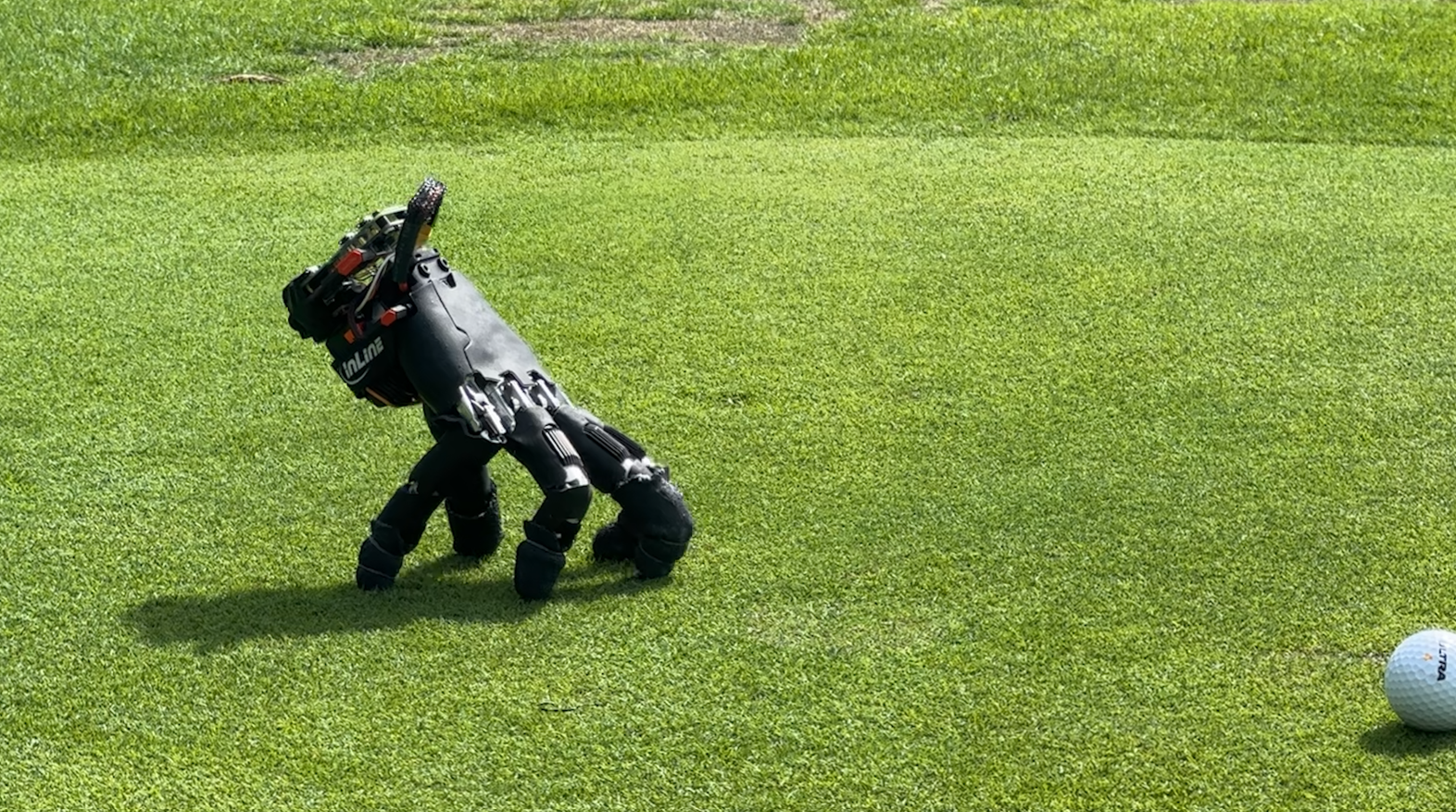
Scientists at ETH Zürich have developed a robotic hand that’s able to creep around the floor using its fingers.
If the design looks vaguely familiar to you, you’re not wrong.
“Thing was definitely an inspiration. I’m an Addams Family fan,” Amir Kazemipour, PhD Candidate at ETH Zürich’s Soft Robotics Lab, told IFLScience.
However, the project did have a serious point. After developing robotic hardware built for handling objects, the team wanted to see whether they could construct a hand that was nimble enough to move on its own.
But achieving this, the team explained, was easier said than done.
“The human-like shape made that surprisingly tricky,” added Kazemipour. “Instead of a regular arrangement of legs, you have five fingers with different lengths and an offset thumb.”
“We kept that anatomy intact and used reinforcement learning to find movements that work with it. Measuring the real hand’s behaviour also helped us build a simulation that was useful for training, rather than just convincing on screen.”
More broadly, I’m interested in giving specialized robot components enough capability to work separately when useful, while still contributing to the complete robot.
Amir Kazemipour
“There’s another complication: moving a finger changes how the whole hand is supported. Pressing a key or pushing something isn’t just a manipulation task anymore; it’s also a balancing problem,” he said.
Testing Thing's abilities
To demonstrate the robot’s creeping abilities, the researchers tested its strutting on a variety of surfaces, including carpets, hardwood, grass, gravel, and tiles, all of which were traversed with ease.
The robot can even correct itself after a tumble, using its fingers to push itself upright and get back on all five fingers to walk again. When researchers placed it in 25 different awkward positions, it successfully recovered from 21 of them.
The intricacies of the robot were recently published in a preprint paper, which has yet to be peer-reviewed.
A decentralized robot
The central idea is that the creepy hand could form part of a larger “parent” robot. If needed, the hand could drop off and be used to navigate through confined spaces, like crawling through ruins during a search-and-rescue mission.
It's also part of an ethos that aims to make modular robot designs where the whole and the individual components are just as useful in their own right.
“More broadly, I’m interested in giving specialized robot components enough capability to work separately when useful, while still contributing to the complete robot,” stated Kazemipour.
Seemingly by coincidence, another team of Swiss roboticists published their design of a walking robotic hand earlier this year. Although it also bore an incredible similarity to Thing from The Addams Family, this team insisted the design was more inspired by nature, rather than a family of eccentric goths.