Technology
 PUBLISHED


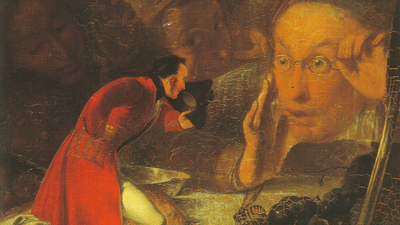


A 300-year-old book is making waves once more, after people have spotted eerie connections to modern-day artificial intelligence (AI) chatbots. Among other achievements in the work, it also came pretty close to predicting the moons of Mars.
In 1726, the first edition of Jonathan Swift's classic Travels into Several Remote Nations of the World. In Four Parts. By Lemuel Gulliver, First a Surgeon, and then a Captain of Several Ships was published, describing the journey of a fictional Englishman who travels to several strange lands, satirizing various real-world political systems as well as human nature in general.
It eventually became known by the more familiar name of Gulliver's Travels, and has become a classic of English literature, read around the world.
The bit that everyone remembers about that book is usually Gulliver's travels to Lilliput, where he wakes up following a shipwreck to discover that he has been tied to the ground by tiny Lilliputians, jabbing at him with tiny spears.
The tiny Lilliputians, after dealing with flooding issues emanating from Gulliver's penis, and wheelbarrowing away his ginormous poops, reveal that they are in a war with Blefuscu, a nation less than a kilometer away, over which end of an egg you should crack. This was Swift's satire on the split in Christianity between Protestantism and Catholicism, and it's no wonder it stuck in people's memories.
But it isn't called "Gulliver's Travel" (singular), and the work describes several other imaginary voyages to distant lands, where the protagonist meets everyone from a population of rational horses, to a beastly creature that resembles humans and is despised wholeheartedly by the horses.
In book III, Gulliver visits the Great Academy of Lagado, an institution where academic "projectors" studied seemingly nonsense ideas, whilst the city below was in poverty. Projects include trying to turn poop back into food, and extracting sunlight from cucumbers.
Interestingly (though don't get too excited) in this section Gulliver meets astronomers who have found two satellites orbiting Mars, 151 years before Phobos and Deimos were discovered.
"They have likewise discovered two lesser stars, or satellites, which re- volve about Mars; whereof the innermost is distant from the center of the primary planet exactly three of his diameters, and the outermost, five," Swift wrote.
"The former revolves in the space of ten hours, and the latter in twenty-one and a half; so that the squares of their periodical times are very near in the same proportion with the cubes of their distance, from the center of Mars; which evidently shows them to be governed by the same law of gravitation that influences the other heavenly bodies."
That is remarkably close to the real orbits of Mars's moons, with Phobos having an orbital period of 7.66 hours, and Deimos having an orbital period of 30.35 hours. But Swift was not some sort of psychic so much as a man who was aware of Kepler's laws, and had done his homework, reading papers on Jupiter's satellites and making some realistic (for the time) guesses based on Mars's presumed diameter at the time.
Then there is "the engine", which is genuinely eerily prescient.
Gulliver meets an engineer who has created a giant machine of wood and wires, which could allow that "the most ignorant person, at a reasonable charge, and with little bodily labor, might write books in philosophy, poetry, politics, laws, mathematics, and theology, without the least assistance from genius or study."
The engine essentially worked by having every word in the language within it, and it would spit out words in various orders, which scribes would then note down.
"The pupils, at his command, took each of them hold of an iron handle, whereof there were forty fixed round the edges of the frame; and giving them a sudden turn, the whole disposition of the words was entirely changed," the book reads.
"He then commanded six-and-thirty of the lads, to read the several lines softly, as they appeared upon the frame; and where they found three or four words together that might make part of a sentence, they dictated to the four remaining boys, who were scribes. This work was repeated three or four times, and at every turn, the engine was so contrived, that the words shifted into new places, as the square bits of wood moved upside down."
The pupils diligently noted down these largely useless fragments of text, which the engineer hoped would one day "give the world a complete body of all arts and sciences".
Again, somewhat mirroring modern-day chatbot issues, the inventor of the machine wanted huge investment to create 500 of these machines, which remained useless and unable to generate new knowledge. All while the people below remained in poverty.
The parallels are pretty easy to see, with the promise of delivering knowledge without study to anybody who might use it, and heavy investment required in a machine that has not proven its value. The machine separated the production of text from the understanding of text, similar to the ways in which large language models (LLMs) work.
While a little eerie (especially coming long before computers) again he was not predicting the future so much as he was satirizing his own time, and his own thoughts on the Royal Society. The section is satirizing commitment to ideas and projects and the production of knowledge without practical decision-making.
Meanwhile, the machine can clearly not produce real knowledge, with it being left to "the most ignorant person" to decide whether the sentences it spits out are worth pursuing. Which sounds like a bit of a recipe for disaster, so thank goodness that isn't happening with current day chat... oh.