Space and Physics
 PUBLISHED
 1
1



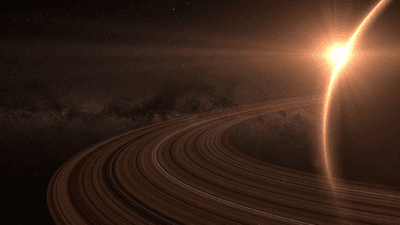


Mars is known for its iconic red color and stunning set of rings. Sorry, no, that latter fact is actually several tens of millions of years too early, but it is coming. The Red Planet will eventually sport a series of rings once its moon Phobos has broken apart. And according to new research, the potato-shaped moon might not have to travel as far as we once thought before it starts losing material, accelerating the timeline of its destruction.
Mars has two moons: Phobos and Deimos. Phobos is larger and closer to the Red Planet, and together they might once have been part of a larger moon or a chunk of the Red Planet itself.
Compared with our own enormous Moon, Phobos is tiny. It's only 27 by 22 by 18 kilometers (17 by 14 by 11 miles). At about 9,400 kilometers (5,800 miles) from the center of Mars, it orbits close enough that, even at its minuscule size, it can produce solar eclipses. This proximity is sealing its doom.
Phobos is already within Mars' Roche Limit. This is the region where the gravity of a planet can tear apart a moon or another small body. If Phobos were liquid, it would already have disintegrated. Since it isn't, the little moon is safe for now. But new research has set out to understand how close Phobos can get to Mars before it breaks apart, and it is much farther out than previous simulations.
Scientists at Côte d'Azur Observatory in France have simulated Phobos not as a solid object but as a loosely held-together pile of rocks, similar to asteroid Bennu and asteroid Ryugu, which were visited by missions in the last few years, and the binary asteroid system Didymos and Dimorphos, whose orbit was shifted by planetary defense mission DART.
Phobos is at an average distance of 2.76 Martian radii, and the team estimates that if its structure is akin to that of a pile of rubble, it will be game over by 2.03 Martian radii or 6,682 kilometers (4,276 miles).
In the rubble pile scenario, the first breaking apart actually starts much earlier, when the moon is at 2.25 Martian radii. If the rate of orbital decay were to stay the same, at 1.8 centimeters per year, Phobos will begin to fall apart in about 94 million years.
The question of the future (and the past) of Phobos is an interesting one. There is an idea that the destruction of Phobos and the formation of rings are cyclical. Every time, a bit more material falls onto Mars, and the moon becomes a bit smaller. A moon that is akin to a pile of rubble would work in this scenario, but the timings might have to be reassessed.
To take this research forward, there are several questions that need to be answered. Is this loosely held-together version of Phobos consistent with surface features such as its giant crater, a strange chain of craters, stripes, and more? The answer might soon be coming from the Japan Aerospace Exploration Agency (JAXA).
The Martian Moons eXploration (MMX) mission will launch between November and December this year, study Phobos, and return with a surface sample in 2031. We will hopefully solve the mystery of its origin and its future with that data.
A paper describing this hypothesis is published in the journal Astronomy & Astrophysics.
[h/t: BBC Sky At Night]