Space and Physics
 PUBLISHED





What you'll discover in this article
- For the first time, a galaxy with three supermassive black holes has been found in the early universe.
- Two lie near the galactic center and are on the path to merging, while the third carries a mystery.
- In an interview with IFLScience, Dr Hannah Übler from the Max Planck Institute of Extraterrestrial Physics says that we need "data at higher spatial and spectral resolution [to] help us to better study the gas kinematics around the black holes."
A galaxy 12.5 billion light years away has been found to contain three supermassive black holes (SMBHs), two of which are probably on a journey to merging, while the other’s presence on the outskirts needs a little more explaining.
All three SMBHs are actively feeding, and shaping the development of the galaxy around them. Their discovery settles some debates about the evolution of the early universe, while opening up several more.
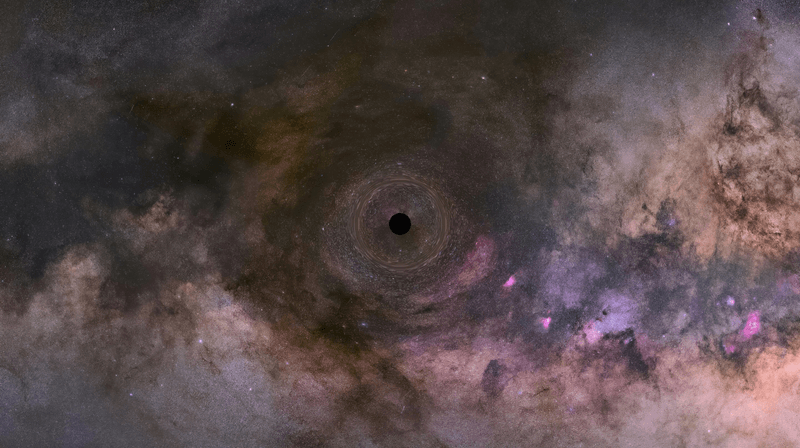
Surrounding SMBHs are what are known as active galactic nuclei (AGN). These are compact regions that emit extraordinary amounts of energy and are therefore the brightest things in the Universe, allowing us to see the black holes from the first few billion years after the Big Bang.
But they don't give us much resolution, leaving open many questions, including how some appear to have grown larger than theory says should be possible for their age.
One explanation would be if many smaller black holes merged at surprisingly fast rates, but proving this is challenging.
However, when astronomers look at the galaxy J0148-4214 they see signs of two SMBHs that will merge soon (cosmological definitions of soon being a few hundred million years). Meanwhile, a third black hole in the same galaxy adds to a picture of galactic development more rapid than has generally been expected.
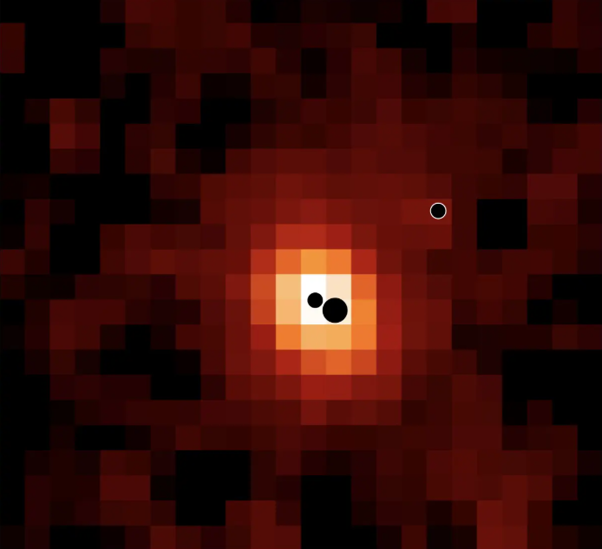
“This is the first evidence of three active black holes in a single galaxy in the distant Universe,” Dr Hannah Übler of the Max Planck Institute of Extraterrestrial Physics said in a statement.
J0148-4214 is far too distant for the two black holes to be resolved separately, but their combined light is asymmetric. This suggests two objects of different sizes.
One black hole is hungrier than the other
The spectrum of light from J0148-4214 has the broad bands associated with very fast-moving material. Although supernovae and some other astronomical phenomena can also produce similar-looking broad lines, Übler and co-authors concluded that what they are seeing only matches what is produced by the accretion disks around black holes.
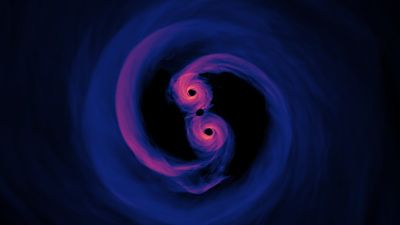
More specifically, the light is consistent with one 80 million solar masses SMBH, while the other has 0.6 million solar masses. The two are about 620 light years apart, and the friction of the smaller object’s movement through an area thick with gas and dust will almost certainly see its orbit decay until they merge.
The authors admit to large error bars on the mass estimates, saying getting the masses precise is not the priority of the paper. However, they note that the much smaller SMBH is feeding at a phenomenal rate, exceeding the Eddington Limit for its size, once regarded as the maximum at which at which a black hole could grow.
“Observationally, many sources have been found accreting above the Eddington limit,” Übler told IFLScience. “The Eddington limit is a simplified theoretical threshold assuming, for instance, spherical symmetry. Real AGN are more complex, and thus accretion above the limit is in principle not unexpected.”
Although such feeding rates depend on the environment around the black hole, and the two share a common galactic center, Übler added that their conditions are not expected to be similar enough that they should be feeding at the same rate.
Indeed, she noted some models suggest that when two black holes share an accretion disk, the smaller hole will usually feed faster.
The galaxy as a whole has a mass of 1.3 billion Suns, making it quite small for such a large central black hole, even before the second SMBH is swallowed.
What’s the interloper’s story?
But it doesn't stop there. Because a third SMBH with about two million solar masses sits on the outskirts of J0148-4214, around 5,500 light years from the pair at the center.
The most obvious explanation for the three SMBHs is that J0148-4214 is a composite of three galaxies, each of which had its own SMBH before the merger. That’s certainly plausible. We know that galaxies like our own grew through consuming smaller galaxies, most of which probably had an SMBH of their own.
However, the authors also consider it possible the third black hole is going in the opposite direction and leaving the galaxy, rather than being in the early stages of capture. This could be the result of a three-body interaction, which can kick one object away from the other two.
“There is a body of theoretical work that shows that when two black holes merge, the end product (a single black hole) can receive a push in a certain direction, and this depends on properties such as the spin of the previous two black holes,” Übler explained.
Determining if the third hole is coming or going is “a very interesting question,” says Übler.
“Data at higher spatial and spectral resolution would help us to better study the gas kinematics around the black holes, and this could provide some clues. Overall, it seems more plausible to think that the third black hole is sinking towards the centre, perhaps having been brought in through a minor merger.”
But if the hole is actually an escapee, the team are keen to know how much material it will take with it, and thus whether other SMBHs are roaming the universe. If so, they may be almost undetectable because they’ve used up all the gas they might feed on, which definitely won't give anyone nightmares.
The study is open access in Astronomy and Astrophysics.