Space and Physics
 PUBLISHED



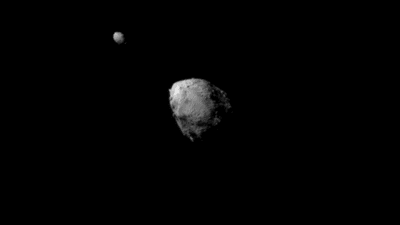


In 2022, NASA performed the first demonstration of planetary defense against an asteroid strike. The spacecraft DART successfully hit asteroid Dimorphos, the small moon of a larger asteroid called Didymos, changing Dimorphos's orbital speed around the larger asteroid and showing that we can use a kinetic impactor to protect ourselves from dangerous space rocks. Now we know we also changed Didymos's orbit around the sun, and we did so without even touching it.
We knew the impact on Dimorphos − which is about 160 meters across compared with Didymos's 765 meters − was a lot more effective than expected (it released more debris than predicted, for example, which may end up being the first human-made meteor shower in a few decades). But we hadn't realized until now that the impact and loss of material had shifted the trajectory and speed of the barycenter of the two objects around the Sun − marking a first for our species.
“I want to highlight the fact that this is the first time in history that we have measurably changed the motion of a natural object around the Sun. This proves that if an asteroid is found to have a significant impact hazard with the Earth, we have proven that humanity can do something to protect ourselves,” lead author Dr. Rahil Makadia, from the University of Illinois at Urbana-Champaign, told IFLScience.
That said, Dimorphos and Didymos didn't pose any threat to us; they were chosen due to the ability to track changes in Dimorphos's orbit around Didymos. “I want to emphasize that Didymos was not and is not at any risk of impacting the Earth,” said Makadia.
The change DART imparted is also rather tiny. The asteroid pair was moving around the Sun at 34 kilometers per second (76,055 miles per hour), and the impact slowed it down by 11.7 micrometers per second.
“So, this change is only about 1 part in 3 billion! But this is indeed a significant change because we were able to measure it. We now know that an asteroid system like Didymos can be deflected with a kinetic impact. And we know the amount of deflection for a spacecraft the size of DART,” Dr. Makadia told IFLScience.
The team was able to measure the density of both asteroids. Didymos has a density of 2,600 kilograms per cubic meter, while Dimorphos is 1540 kilograms per cubic meter, far lower than previously thought but in agreement with the idea that the moon formed from the accretion of material shed by a rapidly spinning Didymos.
“Another big result was the measurement of the momentum enhancement factor from DART. We found a value of around 2 for the momentum enhancement factor. This is a key quantity for kinetic impacts. Therefore, this result will help us refine our models and predictions in case an asteroid is ever found to be on a path to impact the Earth in the future,” Makadia explained.
This new work adds to our growing knowledge of planetary defense strategy by showing that you might not need to target the main asteroid in a pair to shift both onto a safer path, if needed. The work will be further refined in the near future.
“The European Space Agency’s Hera spacecraft is on its way to the system now," said Makadia. "When it arrives and studies the asteroids up close, it will give us much more detailed information about their masses, shapes, and internal structure. That will let us tighten our estimates even further and really understand the full impact of DART.”
Hera will reach Dimorphos and Didymos in November this year, where it is expected to conduct a six-month investigation of the two objects.
A paper describing the new insights into the DART impact was published on Science Advances.