Technology
 PUBLISHED


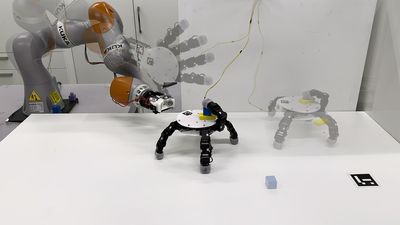


The human hand is often hailed as the “pinnacle of dexterity”, but there’s always room for improvement. In a new study, scientists have developed a nimble-fingered robotic device that puts our fleshy meat pincers to shame.
The robot is the work of researchers from the Swiss Federal Institute of Technology in Lausanne. Set around a 16-centimeter (over 6-inch) palm, it’s armed with up to six silicone-tipped fingers that can master 33 types of grasp and hold actions to grip objects weighing up to 2 kilograms (4.4 pounds).
Unlike the human hand, the robotic hand is able to grasp objects from both sides of its palm. Equipped with highly nimble, multi-jointed fingers, the device can clutch multiple objects simultaneously with a vice-like grip.
“There is no real limitation in the number of objects it can hold; if we need to hold more objects, we simply add more fingers,” Aude Billard, study author and head of the Learning Algorithms and Systems Laboratory at the Swiss Federal Institute of Technology in Lausanne, said in a statement.
Most strikingly, it’s able to detach from its arm and crawl around, just like Thing from The Addams Family. The hand can drop to the floor and crawl across surfaces, using its fingers as legs to walk like a spider, all while maintaining its ability to retrieve and carry objects.
“Our device reliably and seamlessly performs ‘loco manipulation’ – stationary manipulation combined with autonomous mobility – which we believe has great potential for industrial, service, and exploratory robotics,” explained Billard.
Although the robot may look like a high-tech vision from the future, the researchers say its form was actually inspired by the natural world.
“Many organisms have evolved versatile limbs that seamlessly switch between different functionalities like grasping and locomotion. For example, the octopus uses its flexible arms both to crawl across the seafloor and open shells, while in the insect world, the praying mantis use specialized limbs for locomotion and prey capture,” Billard said.
The researchers envision a wide range of applications, from autonomous industrial robots to scientific exploration in challenging environments. Perhaps most intriguingly, the design could even influence the next generation of prosthetic limbs.
“The symmetrical, reversible functionality is particularly valuable in scenarios where users could benefit from capabilities beyond normal human function,” Billard says. “For example, previous studies with users of additional robotic fingers demonstrate the brain’s remarkable adaptability to integrate additional appendages, suggesting that our non-traditional configuration could even serve in specialized environments requiring augmented manipulation abilities.”
The study is published in the journal Nature Communications.


 2
2