


 Space and Physics
 PUBLISHED


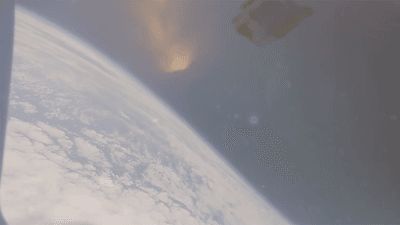


The fastest human-made object, with very little competition, is NASA's Parker Solar Probe. This badass little sungrazer, after several gravity assists from our old friend/hell-world Venus, set the speed record at 635,266 kilometers (394,736 miles) per hour back in 2023.
At these speeds, it would take around 23.4 seconds to cross the US from coast to coast. In 2024, it smashed its own record, this time clocking in at around 690,000 kilometers per hour (430,000 miles per hour).
But that is an uncrewed spacecraft, with absolutely nobody strapped to the back of it as it dives towards the Sun to observe the solar wind. What is the fastest that humans have ever traveled?
Artemis II, the US mission that saw astronauts fly around the Moon as a prelude to Artemis III astronauts also not landing on the Moon, was touted as a record-breaker ahead of time. According to pre-mission briefings, the crew would set several records as they took on their mission of traveling around the Moon for the first time in over half a century.
The crew did end up breaking one record, and setting several firsts. For example, Reid Wiseman became the oldest person to go around the Moon, Meanwhile, Christina Koch became the first woman to go beyond low-Earth orbit and enter the lunar environment, and Victor Glover became the first Black man to achieve the same.
Then there was the big record that got broken by the whole crew.
"Four astronauts aboard NASA’s Artemis II test flight around the Moon made history at 12:56 p.m. CDT on Monday, traveling 248,655 miles from Earth, surpassing the record for human spaceflight’s farthest distance previously set by the Apollo 13 mission in 1970," NASA explained of the main event.
"At its farthest point, crew inside the Orion spacecraft will have traveled about 252,756 miles, before looping back toward our home planet, setting the new record for human spaceflight."
One record was noticeably absent, however. Ahead of the mission, it did look as though the crew would break the human speed record, as they were expected to reenter our atmosphere at 40,000 kilometers (25,000 miles) per hour. In the end though, following problems with Artemis I's heat shields, NASA chose to go for a more gradual "lofted entry" into our atmosphere to reduce stress on the spacecraft.
As it was, the spacecraft came into our atmosphere at a "leisurely" 39,472 kilometers (24,527 miles) per hour.
Whilst still being "really, really fast", that's not quite as as fast as the record set by Apollo 10, which reentered our atmosphere slightly faster at 39,937 kilometers (24,816 miles) an hour.

 1
1