Space and Physics
 PUBLISHED


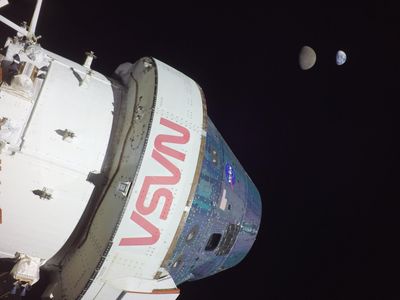


Everything being well, on April 1, Artemis II will launch towards the Moon. In its 10-day mission, the crew will travel around our natural satellite, seeing areas of the Moon never seen directly by humans before. The crew is made up of NASA astronauts Reid Wiseman, Victor Glover, and Christina Koch, along with Canadian Space Agency astronaut Jeremy Hansen. They will be the first humans to return to deep space since Apollo 17 in 1972. Koch will be the first woman and Glover the first Black person to go to deep space.
In the five decades since the end of the Apollo program, much has changed in astronautics. The differences between the Apollo capsules and Artemis II’s Orion spacecraft are significant, and that means that the astronauts will travel with more comfort, more amenities, and a lot more safety.
Not an itty-bitty living Space, but not the Enterprise
The cost of sending something into orbit is still significant, so every kilo counts. The design of the spacecraft is to maximize comfort at the minimum possible weight. This means that while Orion is roomier than the Apollo command and service module, it is still not palatial.
Apollo had a volume of 6.2 cubic meters (218 feet), and it was shared by three people. The configuration for Orion depends on the specific Artemis mission, but it is estimated to be around 330 cubic feet, or just about 9 cubic meters, give or take half a cubic meter.
Orion’s volume is like a 2.08-by-2.08-by-2.08-meter (roughly 7-by-7-by-7-foot) room, which is certainly not small until you remember that you are sharing it with three other people, and it is also your bedroom, kitchen, dining room, bathroom, and workplace. That said, a room on Earth has a specific direction dictated by gravity. In space, all the volume can be enjoyed.
In fact, the team that worked on the design often describes how it feels a lot roomier than it actually is.
Amenities never before sent to deep space
Artemis has 30 percent more habitable space than Apollo, and despite the extra crewmember, it utilizes it a lot better. The different elements of the spacecraft can be reconfigured when the team gets to orbit. The team can maximize the interior volume by storing seats and suits, leaving a large central volume.
Unlike the Apollo mission, Orion has a galley for preparing meals. It also has room for exercise, something essential for astronauts to do in space, as muscle loss begins quickly below a certain gravity threshold. The new cabin is also designed to maximize privacy when required, mitigating noises and odors, and to keep the mission a lot more hygienic.
That includes a toilet – the first one sent into deep space. The clearly named Waste Management System is a critical addition. The Apollo astronauts did not have such a system, which led to the infamous case of floating mystery turds that interrupted the Apollo 10 mission... twice!
“The Orion Waste Management System (WMS) features a full commode suitable for short to mid-length duration missions, offering both privacy and comfortable means for the astronauts to use the bathroom. It employs a small urine tank that is vented to space and replaceable canisters for solid waste storage,” a technical paper on Orion states.
Better tech, more computing power, and increased safety
The leaps forward in computing since the Apollo era are in everybody’s pocket. The single Apollo computer, with 4 kilobytes (KB) of RAM and 72-74 KB of ROM, was less powerful than a modern calculator. Your phone is already light-years ahead of that computer, not just in power but also in weight. Artemis’ Orion sports two simultaneously operating redundant flight computers that each include two redundant computer modules. So, that means four redundant systems, each about 75 percent the weight of Apollo’s lone computer, but with 128,000 times the memory and 20,000 times the speed. This improves safety, data collection, and processing power.
The materials of the capsule have also improved, while 3D printing has become an important part of the design and assembly. The European Service Module (ESM), built by the European Space Agency, uses solar panels for power generation, unlike the fuel cells of the Apollo service module. It is also more compact.
The launch window for Artemis II opens on April 1 at 6:24 pm EDT and will be open for two hours. If it needs to be postponed, the launch will move to the day after, slightly later in the day, until April 6. The reason for this small window of opportunity is that the launch needs to coincide with the right position of the Moon days later, meaning it cannot be launched whenever.
If you want to follow the launch, you can find out how here.