Nature



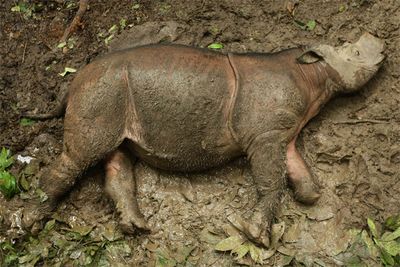


Some animal species exist on the very brink of extinction when populations have shrunk to less than 100 individuals, and the outlook is bleak.
In the forested foothills on the islands of Borneo and Sumatra, this is the case for the last remaining Sumatran rhinos clinging to survival. But a new and potentially highly risky attempt is going to try to save the species.
For the rhinos living on Borneo, of the subspecies Dicerorhinus sumatrensis harrissoni, large-scale habitat loss and hunting have reduced the population to just two known individuals. One of the remaining females is found still living wild in the forests of Kutai Kartanegara regency, East Kalimantan province, and the other in captivity at Indonesia's Kelian rhino sanctuary in Kelian Kartanegara regency.
With no known surviving males, conservation activities have focused on the two females known as Pahu and Pari. Scientists have tried egg retrieval with Pahu, but this was unsuccessful owing to various pre-existing health issues. However, they believe there is a possibility that eggs could be successfully taken from the younger female Pari.
To do this, though, the rhino must be caught in a pit trap and then airlifted to a facility. Pari is currently monitored through remote cameras set up in the forests where she lives.
Because the Bornean rhino and the Sumatran rhino are so closely related, conservationists hope that they can take the eggs from Pari and fertilize them with sperm from a male Sumatran rhino. Interbreeding the two subspecies will then protect some of the genetic diversity from the last remaining Bornean females.
"Sumatran rhinos are larger than Bornean rhinos," said Ari Wibawanto, head of the provincial conservation agency in East Kalimantan, Borneo, reported by APF. "So, if we try to mate them manually or through normal natural mating, it is likely that it will not work properly."
"We take egg cells from the Bornean rhino. We collect them and then fertilize them with sperm from the Sumatran rhino outside the womb." It’s likely that a surrogate rhino would then be used for an embryo transfer or potential pregnancy.
But such a process is not without some pretty high risks. In 2025 a Javan rhino named Musofa died after the world-first translocation of the species, and in 2016 a female Sumatran rhino also died after relocation. In both cases the deaths were linked to previous injuries or conditions.
"We strengthened our procedures to make sure they don't cause technical problems, health issues or behavioral issues, so the animal doesn't get stressed," explained Wibawanto.
The Bornean rhinos are not alone with their troubles, as with the northern white rhino a similar situation has taken place. There remain just two females of the subspecies, neither of which can carry a pregnancy to term.
For years scientists have created embryos using eggs taken from these females and sperm stored before the last male went extinct. While embryos have been transferred into southern white rhino surrogates, the team is yet to see the fruits of their hard work with a successful pregnancy and living rhino calf.