Nature
 PUBLISHED





There are just two northern white rhinos left in the world, a mother and daughter pair at a conservancy in Kenya. Given that they are both female, and the last male northern white rhino died in 2018, you might think it's the end for this species. However, scientists aren't giving up yet.
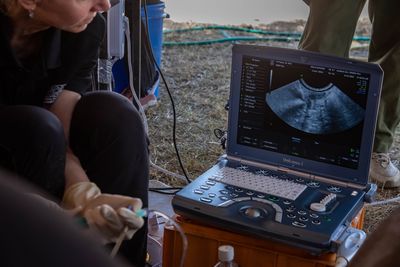
Researchers have been working for years to facilitate the birth of a new Northern white rhino calf. The team regularly harvests eggs from one of the females and has been creating embryos with cryopreserved sperm stored before the last male died.
That work continues, and the latest update brings the total number of northern white rhino embryos created this way to 39. The next step of the process is to implant the embryo into a surrogate, since neither of the two remaining females is able to carry their own offspring.
The chosen surrogate species is the southern white rhino, which is genetically and behaviorally similar and has also been brought back from the brink of extinction. In the second half of 2025, three embryo transfers were conducted into southern white rhino surrogate mothers, but none of these attempts resulted in a successful pregnancy.
One female died while pregnant thanks to a truly unprecedented chain of events: heavy rain washed away the Kenyan topsoil and exposed ancient mummies that had died from bacterial infections. The ancient Clostridia bacteria were still alive and infected Curra, the surrogate. She died within an hour of falling ill.
“It was so fast that there was even a hypothesis that it might have been bitten by a snake, like a black mamba,” Jan Stejskal, coordinator of the BioRescue project, told IFLScience during an interview for The Last Rhinos: A New Hope in 2025. “The first thing was just to work out what we could do so that there were no other mortalities among the other rhinos. Immediately we vaccinated them, so it was a relief that no other rhino died.”
While the team hasn’t met with success so far, two new surrogate mothers have been selected to continue the program in the hopes they can birth a northern white rhino calf. As of April 2026, there have been six more embryo transfers, but still none has succeeded. The team notes that it took more than 100 attempts for IVF in humans to succeed.
As part of their work, the team conducted a survey across three countries – Czechia, Germany, and Italy – to assess public perceptions of these kinds of techniques, called assisted reproductive therapies (ART), which are being used on rhinos and other species.
The survey focused on three areas “regarding the application of classical ART to wildlife conservation, alongside respondents’ attitudes towards the ecological crisis as well as their knowledge about the biodiversity and rhinoceros crises,” explain the authors.
The results found that there is a good level of acceptance of the application of ART in wildlife but that most people see it as a tool for exotic species rather than for the threats that face European species. The results also suggest having a greater emphasis on the combined role of ART and other conservation techniques rather than seeing them as mutually exclusive.
The paper is published in PLOS One.