Nature
 PUBLISHED
 3
3




What you'll discover in this article
- A parasitic fungus thought to be specific to ants has been found to have an “endophytic” phase in which it lives inside mosses without causing disease.
- This includes moss samples collected away from ant graveyards, indicating the fungus’s presence wasn’t the result of an infected ant biting the vegetation.
- Further research is needed to understand if these plants containing the endophytic stage of the fungus are attracting infected insects to bite onto specific locations. “If we can prove it, it would be a groundbreaking discovery,” said study co-author João Paulo Machado de Araújo of the University of Copenhagen.
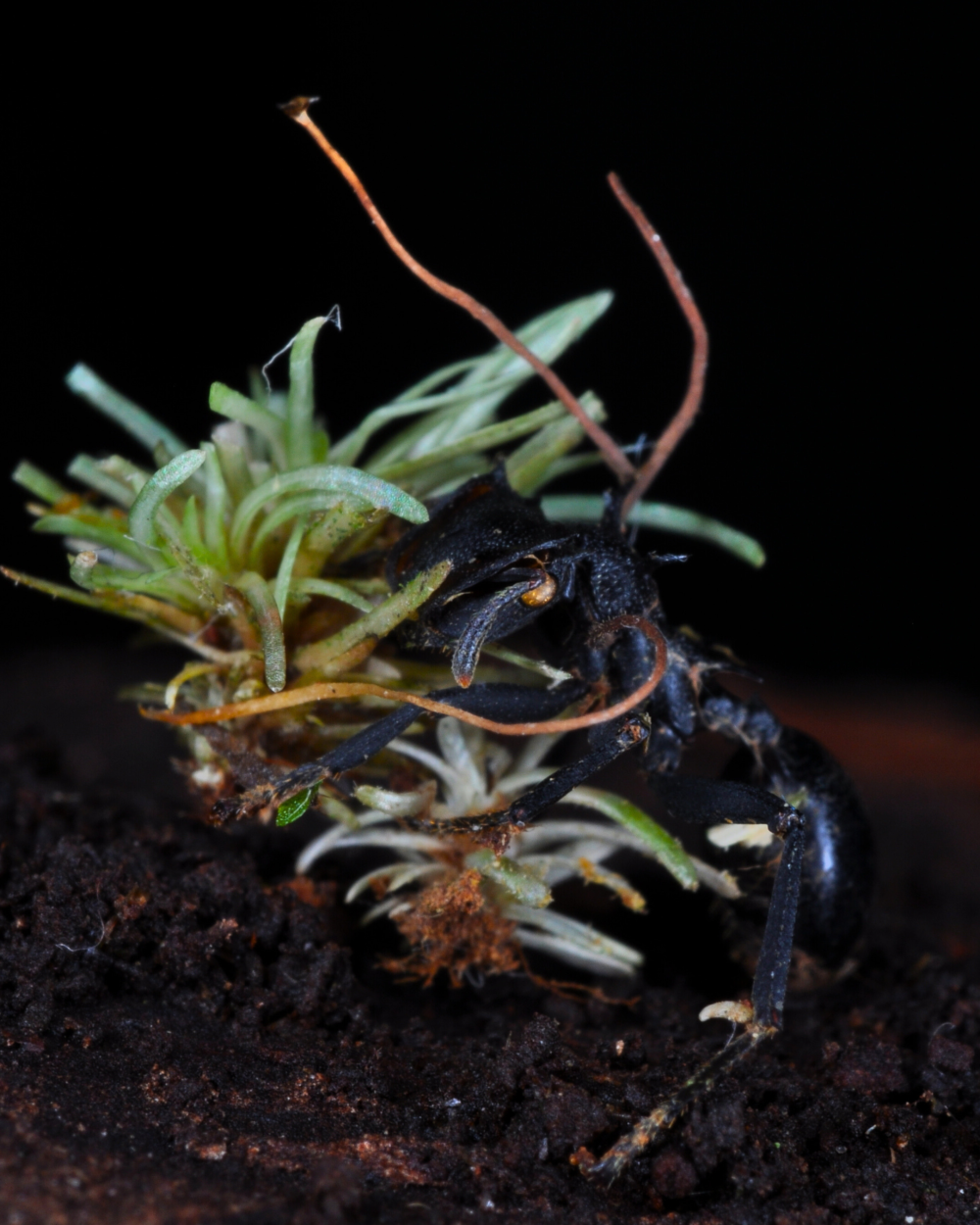
There’s an ant in the Amazon rainforest about to make its final journey, and worst of all, it has no control over it. Its body has become a vessel for the parasitic “zombie-ant fungus” Ophiocordyceps.
Before long it will clamp down in a final “death bite” upon remarkably specific vegetation, joining other fallen comrades in a kind of ant graveyard. The fungus’s fruiting body will grow out of its corpse, a dusty totem that spreads spores and infects other ants.
However, new research has discovered that this is only part of the story.
Zombies in the rainforest
We detected Ophiocordyceps, along with other entomopathogenic genera, in every moss sample collected away from the ant graveyards.
Tales Alves-Júnior
Scientists working in the Adolpho Ducke Forest Reserve in Manaus have made a discovery that’s changing our understanding of the life cycle of these zombie fungi. Once thought to be highly specific in only infecting ant hosts, it now looks as if Ophiocordyceps has been living a secret double life inside an entirely different organism.
It follows the analysis of moss DNA in the Amazon rainforest that revealed the same parasitic fungus is present in mosses; a kind of “endophytic” phase, meaning it lives inside the plants without causing disease.
Perhaps not surprising given these ants bite onto vegetation and therefore probably facilitate some direct spread. That is, until you learn that Ophiocordyceps was found living inside mosses far, far away from these infected ants.
“We detected Ophiocordyceps, along with other entomopathogenic genera, in every moss sample collected away from the ant graveyards. That is, in our control sample,” said study author Tales Alves-Júnior of the Instituto Nacional de Pesquisas da Amazônia (INPA) to IFLScience. “Therefore, the fungus is present in mosses that no infected ant ever bit.”
It might seem unusual that a parasitic species could target two hosts as distantly related as ants and moss, but INPA co-author João Paulo Machado de Araújo of the University of Copenhagen says it’s likely more common than we currently think.
“We have been increasingly finding distinct lineages of entomopathogenic fungi (EPF) associated with plants,” he told IFLScience. “Therefore, I would expect to see more and more linages of primarily insect-associated fungi (at least more obviously observed) as plant endophytes.”
The behavior manipulation might involve not only the EPF and the host insect, but other factors linked to the plant they bite upon manipulation, and their associated mycobiome.
João Paulo Machado de Araújo
The discovery changes our understanding of the life cycle of these Amazonian fungi in suggesting that “zombie ants” may only reflect part of the story.
It’s already been established in cooler climates that some parasitic fungi can live harmlessly in plants as well as infecting insects, but it’s the first time this phase has been identified in the Amazon.
And the story gets weirder still.
Zombie mimics
In 2018, Machado de Araújo and colleagues published a paper describing several new species of the parasitic fungi genus from this same locality.
One of them, O. monacidis, produces a fruiting body that closely resembles the sporophyte of Octoblepharum, which is the same moss “zombie ants” are typically found buried in. It's also the same moss the researchers found Ophiocordyceps living in as a endophyte.
So, does the infection go further?
It is possible that these plants containing the endophytic stage of the fungus are attracting its EPF counterpart in the insect to bite onto specific locations.
João Paulo Machado de Araújo
“To me, the most remarkable aspect in this discovery is that the behavior manipulation might involve not only the EPF and the host insect, but other factors linked to the plant they bite upon manipulation, and their associated mycobiome,” said Machado de Araújo.
“It is possible that these plants containing the endophytic stage of the fungus are attracting its EPF counterpart in the insect to bite onto specific locations. If we can prove it, it would be a groundbreaking discovery that can help us to understand possible applications of these fungi as biocontrol of crop pests, for example.”
Someone get onto The Last Of Us writers. It’s time for an update.
The study is published in IMA Fungus, a publication name other journals should take note of.