Nature
 PUBLISHED
 1
1


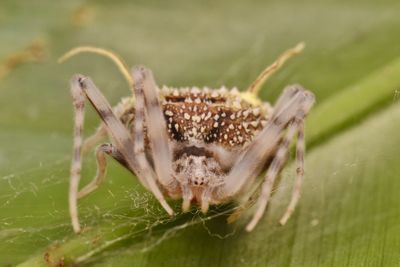


Spiders are the masters of disguise. Some species mimic bird poop, others dress up like ants. But a new species has been found that mimics a deadly fungal parasite.
The newly named Taczanowskia waska can be found in the rainforests of Ecuador, where researchers found it doing its best performance of a dead spider infected with a parasitic fungus.
This is the first time that a spider has been found to imitate a parasitic fungus, and the team behind the discovery thinks it is probably doing it to hide from predators and sneak up on prey.
The researchers first found the spider hanging upside down under a leaf “in the exact same position” as the fungus that it is mimicking. In fact, so good was its disguise that the scientists themselves thought it was a dead, infected spider before touching it caused the arachnid to move.
“The pallid abdominal coloration with small, white spikes perfectly imitates the mycelium of the fungus,” write the authors. “The two stroma-like tubercles look just like the fungal structures of the Gibellula, with the yellow, hairy pattern at the base of the tubercles appearing to be mycelium.”
“The position of the spider and its unresolving stillness perfectly imitate a dead spider with a fungal pathogen.”
The spider is copying an infection from a genus called Gibellula, of which around a dozen species are known to infect arachnids. Belonging to the same group of fungi that also includes Cordyceps, when the fungus infects a spider it penetrates the host with its root-like mycelium, which envelops the unlucky arachnid and slowly digests the victim.
The fungus will then send out little antenna-like structures to release spores and continue to spread the horror. This is seemingly what the clever little spider is mimicking.
It’s been named Taczanowskia waska in honor of the Waska Amazonía Foundation, where the new species was found. Very little is known about the species.
It was first brought to the attention of scientists by a post on the nature recording app iNaturalist. After then finding an individual in the wild, it was confirmed to be a new species by comparing it to museum specimens, of which they managed to find one example in the Hamburg Museum of Nature, Germany, collected in Bolivia in 1903.
“Finds like these demonstrate the value of scientific collections,” said Nadine Dupérré, of the Museum of Nature Hamburg of the Leibniz Institute for the Analysis of Biodiversity Change, in a statement.
“They enable us to classify new species and compare them with historical specimens. Combined with international collaboration and citizen science, this opens up new opportunities for researching biodiversity.”
The genus itself is rare and not often encountered. But based on other iNaturalist observations, the researchers suspect that there could be at least another four species of spiders mimicking fungal infections, with two of these likely being new species altogether.
The authors write that they “hope that this fascinating creature may be an inspiration to Ecuadorians and a reminder that there remains much to be discovered in our own back yards.”
With only females having been found to date, reports remain unconfirmed if the spider is a fun-guy to be around.
The new species has been described in the journal Zootaxa.