Nature
 PUBLISHED
 11
11


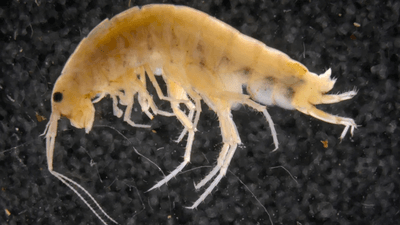


A completely new genus of shrimp was uncovered during an expedition to the Cyclops Mountains in Papua, Indonesia. The unexpected discovery occurred during a challenging 2023 journey and reveals an entirely new habitat for these crustaceans, which are usually found in water.
The expedition was one for the history books, reanimating a species that was thought to have been extinct since the 1960s: Attenborough’s long-beaked echidna, Zaglossus attenboroughi. Named after wildlife broadcaster and natural historian Sir David Attenborough, the monotreme made a surprise appearance on camera traps left in the Cyclops Mountains.
“I'm not joking when I say it came down to the very last SD card that we looked at, from the very last camera that we collected, on the very last day of our expedition,” expedition lead Dr James Kempton of Oxford University told BBC News.
However, while the world was reeling from the reunion, another, arguably more obscure discovery went a little more under the radar. You see, on that same expedition, the team discovered a new genus of ground- and tree-dwelling shrimp.
If you’re thinking, “Well that’s not where shrimp live,” you’d normally be right, and the discovery of these typically water-dwelling crustaceans so high up was a surprise for the scientists, too.
“We were quite shocked to discover this shrimp in the heart of the forest, because it is a remarkable departure from the typical seaside habitat for these animals,” said lead entomologist for the expedition Dr Leonidas-Romanos Davranoglou (a Leverhulme Trust Postdoctoral Fellow at the Oxford University Museum of Natural History), in a statement.
“We believe that the high level of rainfall in the Cyclops Mountains means the humidity is great enough for these creatures to live entirely on land.”
Your standard shrimp breathes using gills to extract oxygen from water and depending on the species will either live in marine or freshwater environments. To be thriving so far inland must mean this new genus has adapted a way to breathe without being fully submerged in water, as Davranoglou says, perhaps aided by rainfall or humidity.
The team was due a few wins following such a perilous and challenging expedition that put them in sometimes life-threatening situations. They faced earthquakes, causing them to evacuate cave systems, and came across many venomous snakes and spiders.
Several of the team suffered illness and injury. Davranoglou’s arm was broken in two places while another team member contracted malaria, and a third had a leech stuck to their eye for a day and a half before a hospital team could remove it. Despite the perils of the Cyclops Mountains, they've lost no love for the landscape.
“Though some might describe the Cyclops as a ‘Green Hell’, I think the landscape is magical, at once enchanting and dangerous, like something out of a Tolkien book,” said Kempton. “In this environment, the camaraderie between the expedition members was fantastic, with everyone helping to keep up morale. In the evening, we exchanged stories around the fire, all the while surrounded by the hoots and peeps of frogs.”
A previous version of this article first appeared in 2023.