


 Nature
 PUBLISHED


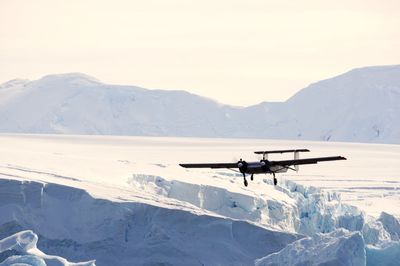


A pilotless aircraft has recently taken to the skies above Antarctica in a test flight that could revolutionize the way scientific data is gathered on the world’s ice-covered continent.
Under the command of the British Antarctic Survey’s (BAS) Rothera Research Station, the Windracers ULTRA UAV is a fully autonomous plane with a 10-meter (32-feet) wingspan, capable of carrying 100 kilograms of cargo and recruitment for up to 1,000 kilometers (621 miles).
Thanks to its high-tech autopilot system, it can take off, fly, and land safely with little input from a human operator.
It’s been specially designed by Windracers, an autonomous drone operator, to deal with the tough Antarctica environment. For instance, if one of its two engines fails, the plane will still be able to fly and make it back to base. Likewise, it's been designed to still function even if certain components are damaged or fail.
The autonomous plane arrived in Antarctica earlier this month and completed its initial test flights this week, logging some 720 kilometers (447 miles) of travel.
“So far so good, everything has very much gone to plan and the Windracers ULTRA has shown that it can robustly gather a range of science data. Our initial flights have been up to 1.5 hours long with even longer missions planned in the next couple of weeks,” Carl Robinson, head of Airborne Survey Technology & UAVs at BAS, said in a statement.
“It’s very early days, but initial data is already showing the platform can collect high-quality environmental information useful to a range science disciplines,” added Tom Jordan, the lead scientist on the project.
The plane will continue its test flights this season as part of a wider experimental project that’s looking to see how autonomous drones could be used to gather environmental data in Antarctica.
During this test phase, the plane is set to carry out an array of tasks, such as assessing ice sheet structures using airborne radar and investigating tectonic structures under Antartica’s ice using magnetic and gravity sensors.
It will also use cameras to document krill, the foundation of the marine food chain, in environmentally sensitive areas. Lastly, its atmospheric turbulence probe will study the complex process of the continent’s oceans and atmosphere.
“We firmly believe that high endurance, high payload autonomous drones have a valuable role to play in the future of environmental research. So it has been hugely rewarding to see the team testing the ULTRA drone in Antarctica and, while it is early days, we’re very encouraged by its achievements so far and the feedback we’ve been receiving from the scientists and engineers on the ground,” stated Stephen Wright, Founder and Chairman of Windracers.
Beyond Antarctica, autonomous planes are achieving all kinds of wild feats. In August 2022, the solar-powered Airbus Zephyr S remained airborne for 64 days, 18 hours, and 26 minutes. While that broke the record for the longest-ever uncrewed flight, it didn’t beat the record set in 1958, which saw two men fly for 64 days, 22 hours, and 19 minutes.
Human pilots have that record for now, but we wouldn't count on them holding it for much longer.



 1
1