Space and Physics
 PUBLISHED


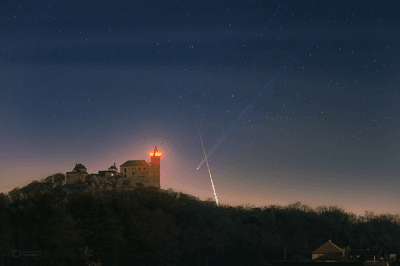


Comet C/2025 R3 (PANSTARRS) is a stargazer's dream. As potentially the brightest comet of 2026, this darting streak of light has given astrophotographers the perfect opportunity to capture some stunning images, and that's without unexpected cameos from other space objects upping the stakes.
One especially outstanding example comes from Petr Horálek, an award-winning astrophotographer from the Czech Republic. While out on a shoot overlooking Kunětice Castle on April 19, he photographed Comet C/2025 R3 just as it was "photobombed" by a passing fireball.
“Later, it was confirmed that the fireball was widely observed over Poland. Combining our data, I was able to show the whole lucky moment,” Horálek explained on his website.
This chance encounter between a fireball and C/2025 R3 is exceptionally rare. The comet takes around 170,000 years to complete a single orbit of the Sun, meaning once this viewing window closes, it won't be seen again in any human lifetime.
C/2025 R3 (PANSTARRS) likely originated in the Oort Cloud, a vast spherical shell surrounding the Solar System that contains billions, or even trillions, of icy bodies. It's a mysterious and theoretical zone that's believed to be the birthplace of long-period comets, which take at least 200 years to orbit the Sun.
This charismatic comet was first spotted on September 8, 2025, with an initial brightness of around magnitude 20. As it drew closer to the Sun over the following months, it brightened steadily, becoming visible through a standard pair of binoculars by March 2026. At perihelion, its closest point to the Sun, on April 19, it reached roughly magnitude 3, bright enough to be seen with the naked eye.
Some astronomers have said it's likely to be the brightest comet of 2026, and potentially the only one visible to amateur observers without any fancy telescopes or even binoculars. However, only time will tell.
Unfortunately, the best of the show is now over for Northern Hemisphere observers. After gracing the eastern horizon just before sunrise in recent weeks, the comet is continuing its journey southward, passing the baton to skywatchers in the Southern Hemisphere, where viewing conditions will improve through late April and into May.
But for those North of the equator, there will be another chance to see it around the year 172,300 CE – at least that’s something to look forward to.