Space and Physics
 PUBLISHED


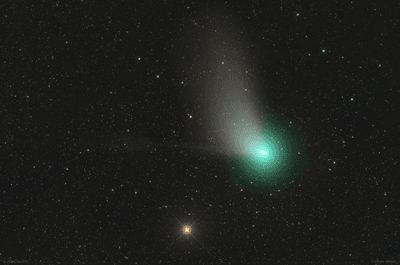


A comet discovered in September last year is currently on track to achieve peak brightness that will almost match Vega, the fifth-brightest star in the night sky. Unfortunately, that peak is likely to occur when Comet C/2025 R3 (PanSTARRS) is too close to the Sun to be visible, but there might be a brief window of naked eye visibility when it’s visible before the Sun rises.
Dozens of comets visit the inner Solar System each year, but most are a small dot in a backyard telescope at best. In the last two years, we have had an unusual run, with five comets that were visible to the naked eye at one point, some more spectacular than others.
At this stage, it doesn’t look like 2026 will continue that run, but comets are also wildly unpredictable, often failing to live up to expectations, and occasionally exceeding them, so any predictions about the brightness of a comet expected to peak more than three months away should be taken with a large helping of salt.
Nevertheless, if you don’t want to wait 35 years until Halley’s Comet returns with a high chance of an excellent show, it’s worth keeping an eye on every comet that has even a chance of turning out well, and over the next six months, that’s pretty much just C/2025 R3 (PANSTARS).
We still don’t know C/2025 R3’s orbital period, but we know it is a long-period comet. Indeed, its orbit is so close to parabolic that this may well be its first approach to the Sun.
Currently, C/2025 R3 is 16th magnitude, making it 10,000 times too faint to see without instruments. There are 18 brighter comets, but unlike those, C/2025 R3 is brightening fast. It’s still 290 million kilometers (170 million miles or twice the distance from the Earth to the Sun) away from the Sun, and a bit further from us.
C/2025 R3 will reach perihelion (closest approach to the Sun) on April 19, about half as far from the Sun as we are. Based on current trends, it will be at fifth magnitude by then, just barely visible to the naked eye under dark skies. Fortunately, the New Moon won't outshine it. Unfortunately, since it will be rising only a little over an hour before sunrise, dark skies will be hard to obtain. But don't worry!
A week later, on April 27, C/2025 R3 will make its closest approach to Earth, and in between is where the fun might happen. Even as it starts moving away from the Sun in reality, our position will see it appear to move closer in the sky, while likely continuing to brighten. All this will be happening as it passes from Pisces into Cetus the whale, crossing near that constellation’s mouth before passing quite close to the Great Nebula in Orion’s sword as it fades.
It's too early to tell if we’ll be able to catch a good view before it disappears into the Sun’s glare, or after it comes out. However, at least anyone trying to catch C/2025 R3 on the outward part of its journey after sunset will have plenty to keep them entertained if the comet itself is disappointing. The western sky after sunset will contain not only the comet, but the two brightest planets, Venus and Jupiter, and Sirius and Orion. Unfortunately, the full Moon will cause trouble around May 1.
With no other comet forecast to reach naked eye visibility this year, that’s a collection worth looking out for.