Nature
 PUBLISHED


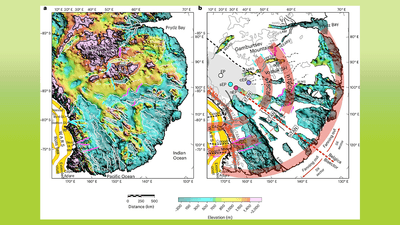


Beneath Antarctica's vast ice sheets exists a hidden continent of towering mountains, gaping valleys, and stretching plains that scientists are only beginning to understand. In the latest breakthrough into this lost world, a team led by the University of Genoa has discovered a system of enormous subglacial basins forming a vast fan-shaped megastructure, not like anything else on Earth.
The giant geological feature sits beneath the East Antarctic Ice Sheet, buried in places under more than 3 kilometers (1.8 miles) of frozen water.
The complex includes several structures that have been identified before, including the Wilkes and Aurora basins. It also encompasses the huge basin that holds Lake Vostok, the largest known subglacial lake on Earth that’s been sealed by ice for 15 to 30 million years.
What's new is the realization that these features aren't isolated. The research shows they form part of a "semi-continental-size" megastructure whose rocky fingers fan outward from a central point near the South Pole. Viewed from above, the team says it resembles a hand, with the triangular gaps between the fingers forming deep basins.
"This research has allowed us to connect structures that until now were considered separate or independent," Egidio Armadillo, professor of Applied Geophysics at the University of Genoa and lead author of the study, said in a translated statement.
"Recognizing a single, large-scale continental architecture significantly changes our understanding of the geological evolution of East Antarctica," Armadillo explained.
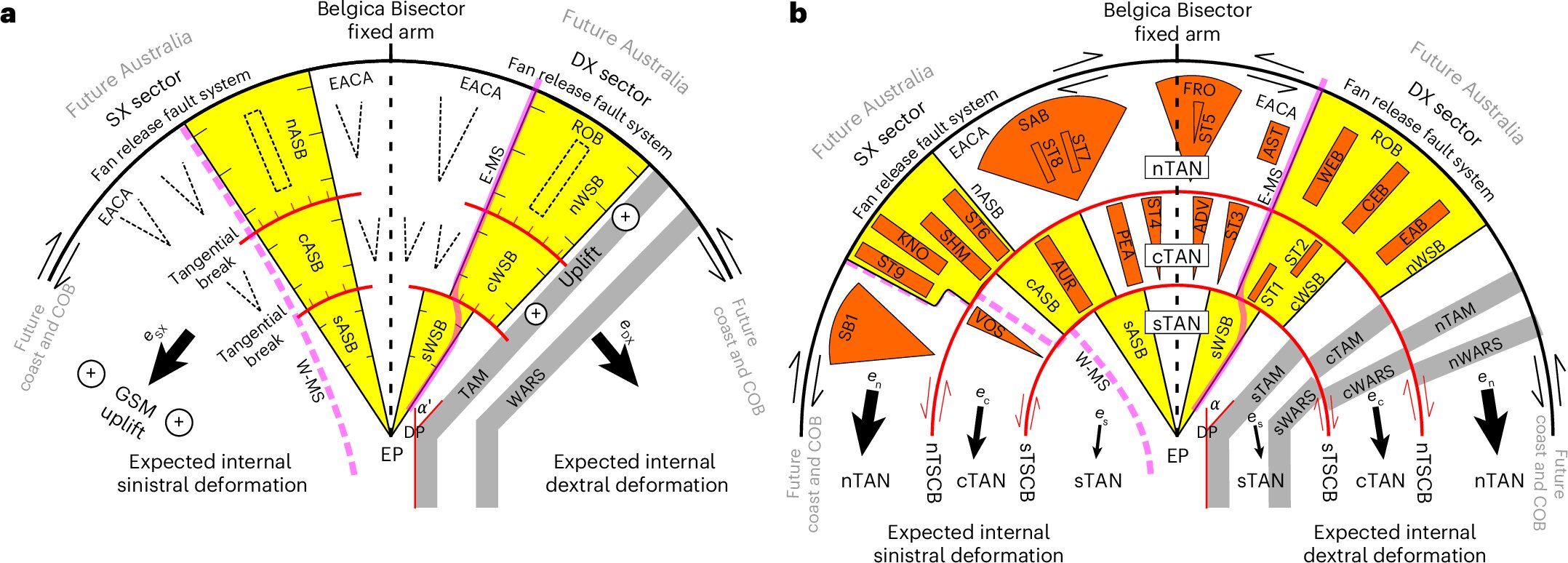
None of this is visible from the surface, unfortunately. The discovery required piecing together data from a wide range of sources – gravity measurements, magnetic data, seismic information, subglacial topography, geological observations, and models of the crust and lithosphere – to effectively peer through the ice.
The question now is how such an unusual and colossal structure formed. Its shape, radiating outward from a central point, suggests it may have been created by distributed rotational extension, a rare process in which continental crust gradually stretches outward from a central point.
The researchers have narrowed the timing down to a few possible periods, including a major erosion event around 250–300 million years ago, the breakup of the supercontinent Gondwana roughly 65–200 million years ago, or a period of fault upset around 35–55 million years ago.
Along with offering a view into the past, the implications stretch into the future. The shape of the bedrock hidden beneath the ice will have an influence on how ice and meltwater move in the decades ahead, a question that grows more urgent as Antarctica continues to warm and lose ice.
All of this is just the beginning of the rich geology that lives beneath Antarctica’s ice sheet. Among the most impressive formations is the Gamburtsev Subglacial Mountains, which rise over 2,743 meters (9,000 feet) above sea level yet remain covered by about 3,048 meters (10,000 feet) of ice. They are the tallest mountains completely hidden under Antarctica's ice – and the tallest mountain range that’s never been seen by human eyes.
The study is published in the journal Nature Geoscience.