Nature
 PUBLISHED
 4
4


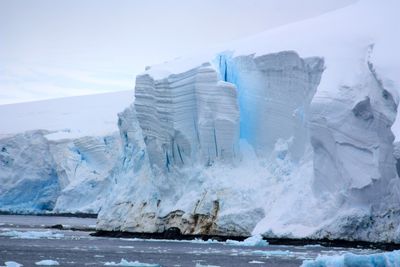


The sea ice coverage in the Arctic has been severely affected by the unfolding climate crisis. Antarctica, on the other hand, has been remarkably stable. Detailed analysis of the last 30 years confirms this finding, but also raises some alarms – vulnerable areas of the southernmost continent have changed dramatically.
The new work revealed that Antarctica lost 12,820 square kilometers (nearly 5,000 square miles) between 1996 and 2025. That’s about twice the size of Delaware, or 10 times the size of Greater Los Angeles.
The changes are happening at the grounding line, basically the shoreline buried under the ice, where glaciers extend from being over the ground onto the water. The team estimated that 77 percent of Antarctica’s grounding line remains stable, but the rest has been losing grounded ice. The ice sheet has been retreating from the grounding line at an average rate of 442 square kilometers (171 square miles) per year.
“The grounding line is where continental ice meets the ocean, and measuring the movement of grounding lines with satellite-based synthetic aperture radar has been our gold standard for documenting ice sheet stability,” lead author Professor Eric Rignot, from UC Irvine, said in a statement. “We’ve known it’s critically important for 30 years, but this is the first time we’ve mapped it comprehensively across all of Antarctica over such a long time span.”
The most affected area was Smith Glacier, losing 42 kilometers (25 miles). Also greatly affected have been West Antarctica’s Amundsen Sea and Getz sectors, where the retreat was up to almost 40 kilometers (24 miles). Pine Island Glacier retreated 33 kilometers (20.5 miles) and Thwaites Glacier retreated 26 kilometers (16.16 miles).
“Where warm ocean water is pushed by winds to reach glaciers, that’s where we see the big wounds in Antarctica,” explained Rignot, who’s also a senior research scientist at NASA’s Jet Propulsion Laboratory. “It’s like the balloon that’s not punctured everywhere, but where it is punctured, it’s punctured deep.”
Fundamental to these insights were observations from a wide variety of satellite missions studying Antarctica from the European Space Agency, Canada, Japan, Italy, and Argentina.
“This work would not have been possible without the unconditional support of international agencies to make observations of the polar regions available to us. As satellite observation capabilities continue to expand, we are looking forward to learning more about the dynamics of these systems so we can better project how they influence sea-level rise in the future,” Rignot said in another statement.
It remains unclear why most of Antarctica remains relatively stable, but this lack of understanding is worrying.
“The flip side is that we should perhaps feel fortunate that all of Antarctica isn’t reacting right now, because we would be in far more trouble,” Rignot added. “But that could be the next step.”
The study is published in the journal Proceedings of the National Academy of Sciences.