Nature
 PUBLISHED
 2
2




Around 99 million years ago, some insects got trapped in tree sap that later fossilized to form what we call amber. Sounds miserable, right? But these insects had already met a far grimmer fate before that sap came along.
It was the age of dinosaurs, but it wasn’t something big and scaly with sharp teeth that got ‘em, oh no. They died at the hands of something the naked eye can’t even see. At least, not until it’s already too late.
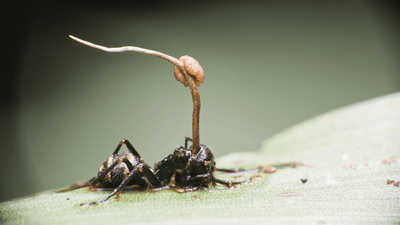
You see, a killer was drifting through the Cretaceous air. One that gets inside its victims and bides its time, directing them like zombies to a good vantage point from which it can come bursting out of their tissues, sending spores far and wide. I’m talking, of course, about zombie fungus.
Reminding you of The Last Of Us? With good reason! The fungal pathogen that got these insects belonged to the same family, known to scientists as Ophiocordyceps unilateralis. The discovery of their grisly fossil remains marks the oldest known evidence of parasitic fungi infecting insects. Step aside, dinosaur-blood-meal mosquito, there’s a new lump of amber we want on our cane.

“It’s fascinating to see some of the strangeness of the natural world that we see today was also present at the height of the age of the dinosaurs,” said Professor Edmund Jarzembowski, an associate scientist at London's Natural History Museum and co-author of the study, in a release emailed to IFLScience.
Beyond their esthetic appeal, the fossils also provide a rare snapshot into the early evolution of entomopathogenic fungi. Though a rather grim life cycle from the vantage point of humans (who love to weep over surprisingly emotional renditions of zombie tales), zombie fungi can do their bit for the environment in keeping thriving populations humble.
“As the infections are lethal, Ophiocordyceps and its fossil relatives likely played an important role in controlling the populations of insects by the Mid-Cretaceous, in a similar way to how their living counterparts do today,” Prof Jarzembowski added.
Finding evidence of this kind of parasitism is rare because we typically need soft tissues to see it. There’s not much of that left in typical fossils this old, but amber has a particular talent for locking all that precious information in, which is what makes this discovery so important. In fact, it’s even enabled us to name two new species: Paleoophiocordyceps gerontoformicae and Paleoophiocordyceps ironomyiae.
Like you an ancient parasite? Perhaps we can tempt you to a very, very old worm that may have come from a dinosaur's butt.
The study is published in the journal Proceedings of the Royal Society B: Biological Sciences.