Humans
 PUBLISHED



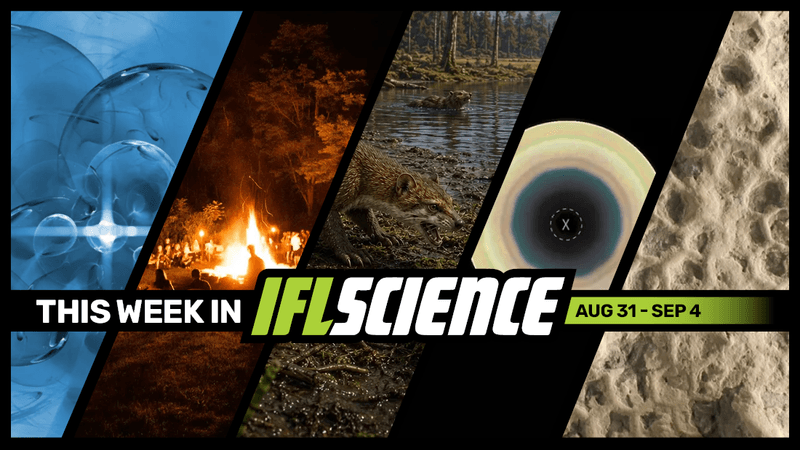
This week, a type of sugar found in raspberries has been discovered near the Milky Way’s center suggesting we may have received sugar from space, the first medical X-rays have been performed on astronauts while in space, and the history of the world’s oldest amber has been rewritten with the discovery of 385 million-year-old fragments. Finally, an 80-year-old math problem has finally been solved using generative AI.
Create an IFLScience account to get all the biggest science news delivered straight to your inbox every Wednesday and Saturday.
$50 Million Dinosaur Sale Smashes Auction Record. Three Palaeontologists Told Us Why That’s Potentially Catastrophic For Science And Education
Sixty-seven million years ago, Gus the T. rex was fighting for his life – just ask the bite marks on his skull (thought to have been made by another T. rex, ouch). Today, he’s just been sold to an anonymous private buyer for $50.1 million. It’s a big number. But then, it could be said that a specimen as complete as Gus is priceless, packed full of information that can teach us about ancient animals, their environment, and behaviors. The bitter irony of it is that all that value could be lost if Gus ends up in somebody’s living room. Read the full story here
Mysterious Masked Monkey Is The Fifth Discovered In Africa In 75 Years. And It May Already Be Endangered
In the depths of the Democratic Republic of the Congo, a new species of colobus monkey with unusual orange lips and a sleek gray mask has been discovered. This represents only the fifth new species of monkey to be described in the past 75 years, and the researchers already think it's endangered. Read the full story here
First Sugar Discovered Near The Milky Way’s Center Shows Our Galaxy Is More Of A Raspberry Milkshake
The first detection of the sugar erythrulose has been made in interstellar space, more specifically in a dust cloud near the center of our galaxy. Erythrulose is produced by raspberries and is used in some cosmetics. From a scientific point of view, however, the more interesting aspect of the discovery is that it adds to evidence that early Earth may have received sugars from space, forming a potential resource for early life. Read the full story here
How The First Medical X-rays In Space Could Not Only Save Astronauts, But Lead To Better Medicines For Us On Earth
For the first time, astronauts have had their bodies X-rayed while in space. This was not because there was anything wrong, but as a proof-of-principle for future missions. For more than a century, X-rays have been a key tool for diagnosis. As space missions get longer, having portable medical equipment that can aid in diagnosis could save lives, as we saw with the first-ever medical evacuation of the ISS earlier this year. Read the full story here
385 Million-Year-Old Fragments Found Inside Coal Rewrites The History Of The World's Oldest Amber
Previously, the oldest amber dated to around 330 million years old, from plants that lived during the Late Carboniferous. Incredibly microscopic pieces of amber have now been found that push back the date by at least 65 million years to the Middle Devonian, before seed plants existed. Read the full story here
TWIS is published weekly on our Linkedin page, join us there for even more content.
Feature of the week:
AI Solved A Math Problem That Had Stumped The World For 80 Years. Not Everyone Is Happy About That
On May 20, 2026, a group of researchers made a surprising announcement: they had, they claimed – and reviewers would later agree – disproved a longstanding open problem originally set by one of the most famous names in modern math. After 80 years, the Erdős unit distance conjecture was finally closed. But that wasn’t what caught people’s eye. What made this result really special wasn’t so much what was proven, but who proved it: an AI. Read the full story here
More content:
Have you seen our e-magazine, CURIOUS? Issue 48, July 2026, is available now. This month, we asked, “What Is Archaeoastronomy?” – check it out for exclusive interviews, book excerpts, long reads, and more.
PLUS, the We Have Questions podcast – an audio version of our coveted CURIOUS e-magazine column – continues. In episode 22, we ask, “Where Is The Human Heart Located?”
The Big Questions podcast is back for season 6! In episode 3, we ask “How Do You Name A New Species?” Host Rachael Funnell sat down with Professor Paul Barrett, a palaeontologist at London’s Natural History Museum, who has seen taxonomy from the other side, naming new species himself.
Our Break It Down podcast now has a new monthly format, coming at you in both audio and visual. So tune in each month to hear about some of the wildest science stories and adventures we’ve been on. Kick off this month with “Artemis II Records, Neanderthal Not-Hybrids, And Introducing ‘Moon Joy’”