Humans
 PUBLISHED


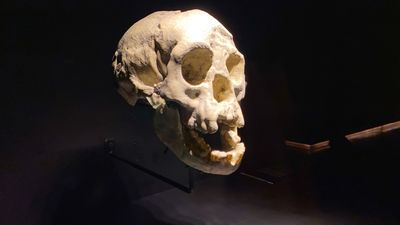


Today, only one human species remains on Earth: us. Scientifically known as Homo sapiens, we are the sole surviving members of the Homo genus. But this was not always the case.
For much of the last several hundred thousand years, multiple human species coexisted across the planet. Over time, however, all of these other human species disappeared, leaving Homo sapiens as the only extant human lineage.
Palaeontologists have long sought to understand why this happened and whether our own ancestors played a role in the extinction of their close relatives. If we rewind the clock to around 300,000 years ago, when Homo sapiens first emerged, we would find a world inhabited by a remarkable variety of human species.
The Neanderthals are probably the most famous of this bunch, but at roughly the same time there were the Denisovans, Homo heidelbergensis, Homo naledi, and Homo erectus, as well as diminutive species of humans on the island of Flores, Homo floresiensis, usually referred to as "the Hobbits". There is some fossil evidence for more species, but the lack of DNA from many of those fragments doesn’t allow for a complete confirmation of other species present at the time.
At least seven human species lived at the same time, for tens of thousands of years. Our ancestors began to move out of Africa around 60,000 years ago, and these migrations coincided with the other species' vanishing. Were we responsible for their extinction? Why are we the only ones who cheated oblivion?
Did Homo sapiens Drive Other Humans to Extinction?
"I wish I could give you a straightforward answer. We don’t frankly know why we’re the only ones left. Obviously, some of them may have disappeared before we spread around the world, but we know that within the last 100,000 years, Homo sapiens, having evolved in Africa, started to come out from Africa," Professor Chris Stringer, human evolution research lead at the Natural History Museum, told IFLScience in our podcast The Big Questions.
This migration out of Africa brought our ancestors into contact with other humans, meeting Neanderthals in Europe, Denisovans in Asia, and other possible species spread around the world.
"Now all of those species that were there less than 100,000 years ago disappeared somehow in that period, so it’s easy to make a connection with the spread of our species and the disappearance of the other species. Some people make a direct connection, and they say: ‘We just killed them all off, that’s easy. We were very superior to them, and they were out-competed, and they died out very quickly.’ In fact, the more we know about this time, the more complicated it looks," said Stringer.
The Neanderthal Puzzle
Of the other species, the one we know the most about is the Neanderthals. Humans shared territories and even mated with them for thousands of years. There’s also evidence that they had already experienced changes in climate and other shocks that might have put them on a decline.
Professor Stringer stressed that we now know that we were not particularly superior to the Neanderthals. They were a capable species. However, we potentially out-competed them for resources when they were struggling, leading to their disappearance.
What Happened to the Other Human Species?
As for the other human species, Stringer said: “We don’t know why the Denisovans died out, but we know that within a few thousand years of Homo sapiens getting to that region of Siberia, they disappeared. Again, you can make this potential connection. [H. Floresiensis], we don’t know what happened to it, and [H. erectus], we don’t know what happened to it. By extrapolation, perhaps the same process has happened to those as well, but we’ve got much less data.”
There is, however, an argument to be made that maybe the Neanderthals have not completely gone extinct. There was interbreeding between Homo sapiens and Neanderthals, between us and Denisovans, and between Neanderthals and Denisovans. We could almost say they disappeared into our gene pool.
“In a sense, the Neanderthals haven’t gone fully extinct because a bit of them lives on in us. Someone calculated that because we don’t all have the same bits of Neanderthal DNA, if you add up all the Neanderthal DNA in the world today in everyone, you could probably reconstruct 40% of the Neanderthal genome without even having a Neanderthal just from the people alive today,” Stringer explained.
An earlier version of this article first appeared in 2024.