Humans
 PUBLISHED


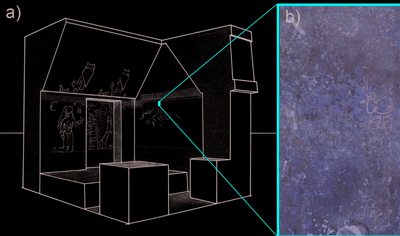


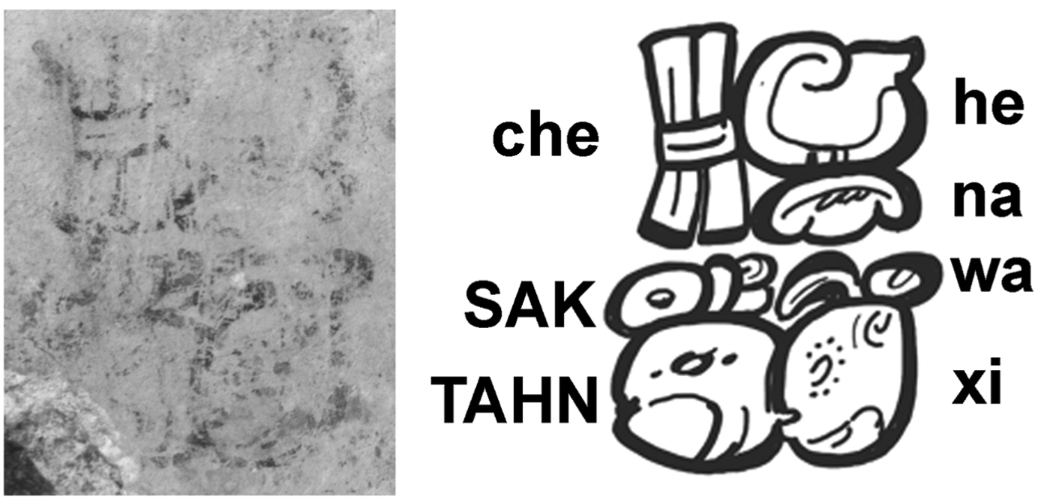
Back in the eighth century CE, ancient Maya mathematician-astronomers gathered in an elite household to compose the complex formulas with which they kept track of time and the movement of celestial bodies. Alongside one of these ingenious works, researchers have now revealed a name: Sak Tahn Waax, which means White-Chested Fox.
The Maya are famous for their remarkably precise astronomical calculations, some of which are recorded in calendrical books called codices. Until now, however, the authorship of these documents had remained a mystery, as the names of the scribes are generally not recorded.
Sak Tahn Waax therefore becomes the first known Maya mathematician, after the scholar’s title was found on the inside wall of a building at the ancient site of Xultun in Guatemala. Thought to date to around 781 CE, the signature was discovered alongside one of 52 mathematical “microtexts” that were scribbled onto a plastered section of wall.
These ‘rough draft’ calculations and tables are akin to finding an early version of a well-known manuscript, or a sketch of a great artwork.
Franco Rossi
Researchers believe these plastered panels acted as “whiteboards”, where mathematician-astronomers jotted down their calculations as they composed the formulae that would later populate codices.
“These ‘rough draft’ calculations and tables are akin to finding an early version of a well-known manuscript, or a sketch of a great artwork,” explained study author Franco Rossi from the Massachusetts Institute of Technology.
“The math involves [Sak Tahn Waax’s] unique understanding of connections and patterns between several cycles of time, including the 260-day ritual day-count, the solar year, as well as the cycles of Venus and Mars,” he told IFLScience.
In their write-up, the researchers explain that the formula provides a unique - and even “playful” - take on the 2,920-day cycle, which appears in numerous Maya codices and relates to the period of time it takes for the position of Venus relative to the Sun to repeat.
“Whether Sak Tahn Waax was onsite and wrote this specific passage or whether it was attributed to him by another remains in question,” says Rossi.
In the same building, researchers discovered a mural depicting both male and female scribes, alongside imagery related to the ruling elites and deities – such as a depiction of the Xultun ruler Yax We’n Chan K’inich, who appears dressed as a Maize-Wind god with a scorpion tail.
“This makes it clear that codices were being made and inscribed in this higher status residential complex,” explains Rossi. “It shows us that such work took place within elite households, with men and women both involved,” he adds.
Whether or not the formula attributed to Sak Tahn Waax ever made it into a Maya codex is unclear, as most of these were destroyed by Spanish priests and only four now survive. However, the presence of a name beneath a mathematical text shows us for the first time that ancient Maya scribes did sign their work.
“[I]n (or near) the year 781 CE, a scholar, perhaps at Xultun, observed the sky and noted the progression of Venus and other planetary bodies in a new way and claimed credit for it,” conclude the researchers.
The study is published in the journal Antiquity.