Nature
 PUBLISHED
 2
2



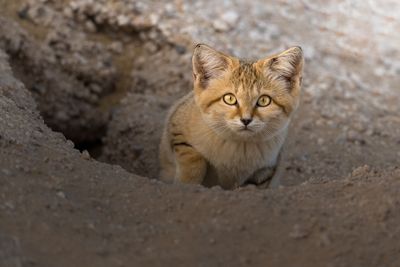


A YouTube video of an adorable sand cat from 2017 has sparked renewed interest in the species and even a scientific study. In the video, you can clearly see the cat as it curls up underneath a shady plant, and while that might sound like pretty standard sand cat behavior, it was filmed in Libya, a country where sand cats don’t live. Or do they?
“When I posted it, nobody believed it had been filmed in Libya,” wildlife photographer Mohammad Almuntasir told the Guardian this week. “Everyone denied it, but I kept insisting that the cat is here, in several places; one of them was only 70km (43 miles) from Zintan, where I live.”
The sand cat (Felis margarita) is the only felid species in the world adapted to live in these desert conditions, but it was previously thought to have a wide but patchy distribution across North Africa and southwest Central Asia. This lack of information could be partly down to the sand cats themselves, as they are incredibly well camouflaged against the sand of the desert. In Libya, smuggling rings also operate, which makes surveying difficult and dangerous, in addition to the tough conditions of the Sahara Desert.
That didn't stop researcher Firas Hayder from Sol Plaatje University in South Africa from getting in touch with Almuntasir. Together, they developed a surveying technique for the area using GPS coordinates and photographs. Almuntasir teamed up with local Tuareg communities, who know the landscape, to help find the sand cats, and the pair got in touch with friends and acquaintances to help find more areas where the they might be hiding.
“Those authors who are local residents frequently engage in camping activities, either out of an interest in wildlife protection and documentation or for hunting purposes. These activities often take them into remote areas, far from their home regions, where they explore wildlife both during the day and at night. Their extensive presence in the field, combined with first hand experience, enabled the collection of valuable observational data,” write the authors in their paper.
The results of their efforts show the first confirmed records of sand cats in Libya, including 13 encounters from one specific area of the country that could be a species stronghold. The results also revealed another species hidden in the desert, the Saharan striped polecat (Poecilictis libyca), which, combined with research efforts from Tunisia and Algeria, represents a much more extensive distribution than previously thought.
The polecat was spotted at eight new locations, seven of which are outside the IUCN’s known range for the species. Two sightings were spotted by authors near their homes, while others were seen by mutual acquaintances.
The team also found that both the sand cat and the polecat were sold at markets either as pets, in the case of the sand cat, or for traditional medicine, a practice that’s common in Tunisia for the polecat and might represent serious concerns about the illegal trade and exploitation of this species.
Given the lack of information about these two species in Libya, the team recommends urgent targeted conservation efforts to better understand and protect these elusive desert mammals.
The paper is published in the Journal of Arid Environments.