Space and Physics
 PUBLISHED




There are currently six planets visible in the night sky, in a lovely planetary parade. All but Mars can be seen after sunset: first Venus and Mercury; then Saturn and Neptune, which are very close to each other; across to Uranus high in the sky; and finally Jupiter towards the east, so bright that you are not going to miss it.
In the Northern Hemisphere we are still in winter, so many of us might not be experiencing the nice, clear nights that would allow us to enjoy this spectacle. Still, it won’t disappear any time soon, and if the clouds reign overhead in the meantime, we can do something else. We can listen to the planets… well, to a sonification of their X-ray emissions and some of their other light.
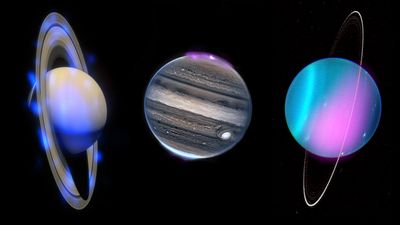
NASA has used data from its Chandra X-ray space telescope and turned it into sound to showcase the peculiar emissions of the planets. Jupiter, Saturn, and Uranus have powerful magnetic fields, producing energetic events that can be spotted in that powerful light.
Jupiter’s magnetosphere is enormous, the largest continuous structure in the Solar System apart from the sphere of influence of the Sun. It extends 7 million kilometers (4.35 million miles) in a sunward direction and almost to the orbit of Saturn away from the Sun. The magnetosphere of Jupiter is 10 times stronger than Earth’s own.
Saturn's magnetosphere is smaller and weaker than Jupiter’s own, but it has peculiar things happening in it, including the geysers of Enceladus, its tiny icy moon, which create electromagnetic waves across the magnetosphere.
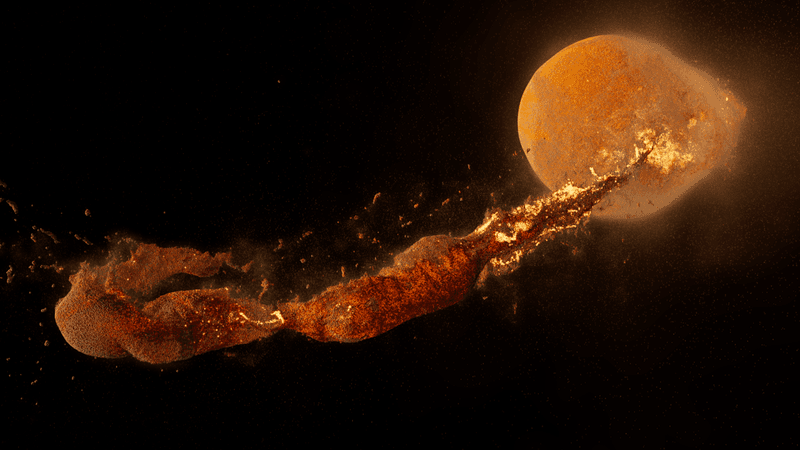
Let us also talk about Uranus. The planet is unique in that its magnetic field does not go through its center, creating the peculiar aurorae seen by Voyager 2 and most recently JWST. A lot of the peculiarities of Uranus are blamed on a giant impact that happened several billion years ago, which messed with the alignment of the magnetic field, but also its atmosphere and rotation. Uranus spins on its side.
These fields and their energies can be tracked in X-rays, and the sonification allows us to experience those measurements in a completely different way. Using different sounds matching infrared observations of Jupiter, Cassini views of Saturn, or even the light reflected off the tenuous rings of Uranus, and all the different X-ray signatures, the sonification produces something incredible.
The planetary parade will continue for weeks, so any day is good for spotting it. Check online planetariums such as The Sky Live for the best views. If you really need to hope for one day of good weather, pick March 7, when Venus, Saturn, and Neptune will be in conjunction, which means very close together. Look for them in the western sky after sunset.
Spotting planets is easy, even with the dim ones like Saturn: they do not twinkle like stars.