Space and Physics
 PUBLISHED




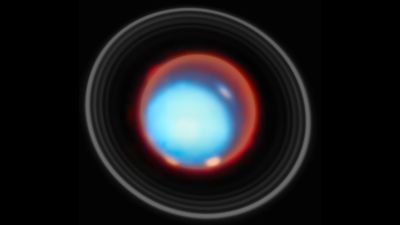


Uranus is an oddball planet. It spins around the Sun on its side, so the poles take turns pointing towards the Sun during the planet’s orbit. Its magnetic field is also very weird: it is tilted by almost 60 degrees from its rotational axis, it doesn’t go through the center but is about off by one-third of the radius, and it might be produced by a saltwater layer rather than a metallic core. That hasn’t stopped the planet from having aurorae, and the latest JWST observations have revealed these and much more.
The observations from the infrared telescope show the temperature and densities of ions in the atmosphere of the planet. The researchers tracked the difference in the 5,000 kilometers (3,000 miles) above the cloud tops of Uranus, showing that density peaks about 1000 kilometers (600 miles) above the clouds, while the temperature peaks at between three and four times that altitude.
The work shows that there are complex variations in the upper atmosphere of the planet, and a lot of this is due to how the lopsided magnetic field influences these outer layers.
“This is the first time we’ve been able to see Uranus’s upper atmosphere in three dimensions,” lead author Paola Tiranti of Northumbria University in the UK said in a statement.
Two particularly important findings have come from this work. The aurorae are located in two bands around the magnetic poles, and the gap between the two bands is likely due to transitions in the planet's magnetic field lines. Something similar has been seen around Jupiter, so even though the internal mechanisms might be different, the magnetic fields might produce effects that look alike.
The other discovery is the cooling of the atmosphere. Combining the observations from JWST with measurements from Voyager 2, other spacecraft, and ground-based telescopes, it is clear that the atmosphere of Uranus has been cooling for decades. The measurements suggest that it is 150°C (270°F) cooler than in the 90s.
“Uranus’s magnetosphere is one of the strangest in the Solar System,” added Tiranti. “It’s tilted and offset from the planet’s rotation axis, which means its auroras sweep across the surface in complex ways."
A lot of the peculiarities of Uranus are being blamed on a giant impact that happened several billion years ago, which messed with the planet’s rotation, magnetic field, and atmosphere.
The research is published in Geophysical Research Letters.