Space and Physics
 PUBLISHED



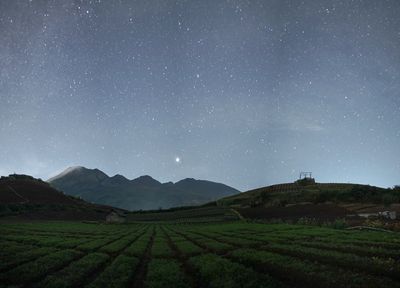


Last year, the night sky provided us with not one but two beautiful planetary parades. The snag for the six-planet parade of August is that it happened before dawn. Very inconsiderate for those of us in the Northern Hemisphere. Well, we are sort of getting an apology at the moment. Weather permitting, over the next several weeks, six of the seven planets will be visible in the night sky. And after sunset! Very considerate; thank you, celestial mechanics!
From west to east, right after sunset, we have Venus and then Mercury. Currently, Venus appears very close to the Sun, but as the month progresses, it will get higher and higher in the sky. Still very close to the Sun are Saturn, visible to the naked eye, and Neptune, which requires a telescope to be seen. Then there’s Uranus, again visible through a telescope (unless you are at a place with very dark skies) in the constellation of Taurus.
Last but not least, there's Jupiter, shining brightly between the twins, the constellation Gemini. You won’t be able to miss Jupiter; it will be the brightest dot out in the sky. Where is Mars? On the other side of the Sun, currently at an angle that makes it unfeasible to see. Basically, it rises with our star, so you can’t even try to spot it before dawn.
The planetary parade is happening right now, so any day is good for spotting it. If you want some particularly exciting dates, hope for good weather on March 7, when Venus, Saturn, and Neptune will be in conjunction, very close in the western sky. Spotting planets is easy, even with the dim ones like Saturn: they do not twinkle like stars.
Planetary parades happen because the planets all orbit roughly on the same plane, the ecliptic. Depending on their relative position around the Sun and the position of Earth, they can all appear on one side or another.
If you want all seven planets in a row, you will have to wait for early 2034. Venus and Mercury will be quite near the Sun, followed by Jupiter, Mars, and Neptune being close together, and then Uranus and Saturn. Another good one will be in 2040, when across August and September, the sky will have all five visible planets very close to each other.