Space and Physics
 PUBLISHED



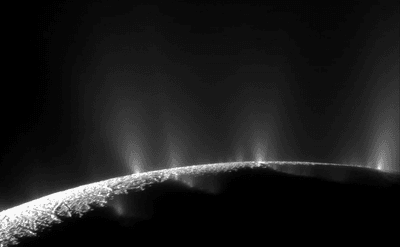


Enceladus is a small moon, much smaller than our own. Comparable to the width of Arizona, this tiny world has a deep ocean with complex chemistry underneath an icy crust. It is one of the most promising places for life beyond Earth. It also turns out to interact with Saturn’s magnetic field at an enormous scale.
The icy moon creates waves 2,000 times its radius. That radius is 250 kilometers (155 miles), but it has been seen stretching its influence for over 504,000 kilometers (over 310,000 miles). The secret of this ability is its geysers, releasing water molecules from the moon’s south pole into the circumplanetary space around Saturn.
These water molecules were already responsible for the formation of the massive and very faint E-ring around Saturn. Researchers have discovered that the water loses electrons, becoming ionized. This electrically charged plasma interacts with the planet’s magnetic field.
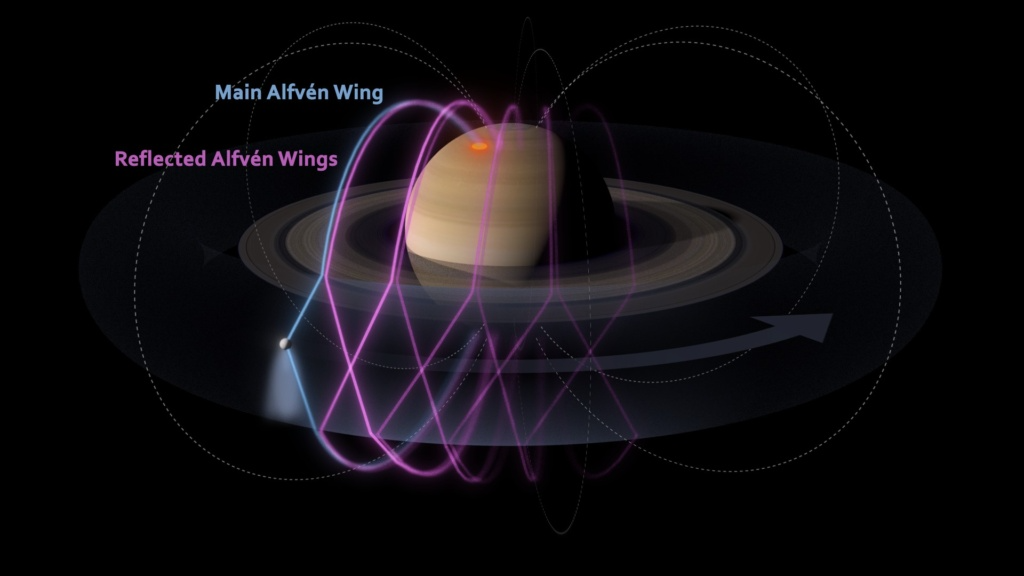
The interaction produces particular types of plasma waves known as Alfvén wings. The main one goes from the moon to the planet, and then multiple Alfvén wings are reflected back, creating an intriguing lattice of plasma around Saturn.
“This is the first time such an extensive electromagnetic reach by Enceladus has been observed, proving that this small moon acts as a giant planetary-scale Alfvén wave generator,” co-author Thomas Chust of Laboratoire de Physique de Plasmas (LPP) said in a statement.
“This work sets the stage for future studies of other systems, such as the icy moons of Jupiter or exoplanets, by showing that a small moon with an electrically-conducting atmosphere can influence its host over vast distances on the scale of the giant planet itself.”
The work was possible thanks to the data from the Cassini mission, a collaboration between NASA, the European Space Agency (ESA), and the Italian Space Agency. The data from the spacecraft’s 13 years around Saturn show that little Enceladus plays a massive role in the energy changes around Saturn.
“Enceladus, Saturn’s small icy moon, is famous for its water geysers, but its actual impact and interaction with the giant planet has remained partly unknown. This result from Cassini transforms our vision of the moon’s role in the Saturnian system,” explained lead author Lina Hadid, also at LPP.
“These results highlight the importance for future missions to Enceladus, such as the planned ESA orbiter and lander in the 2040s, to carry instrumentation that can study these electromagnetic interactions in even more detail.”
ESA has just recently received the funding to explore this incredible mission to Enceladus. Thanks to the geysers, the lander will be able to sample the ocean and maybe learn if it is habitable, or even if it has life.
The study is published in the Journal of Geophysical Research: Space Physics.