Space and Physics
 PUBLISHED



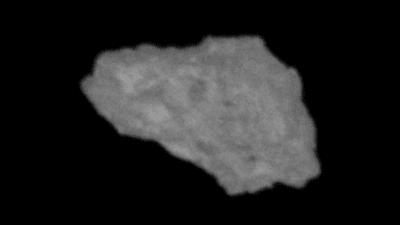


China's Tianwen-2 mission has now officially reached Kamoʻoalewa, a "quasi-satellite" of Earth that generally sits a few tens of times more distant from us than the Moon. We've known about it for a decade, but now we've finally got a real close-up look, with Tianwen-2 currently at about 20 kilometers (12 miles) from the celestial body.
Kamoʻoalewa is estimated to be 16–20 meters (52–66 feet) across, making it the smallest object ever visited by a spacecraft. Among the known quasi-satellites of Earth, it appears to be the most stable; it has been around our planet for a century and will be for several more to come.
You might be wondering what makes an object a quasi-moon. From the point of view of Earth, Kamoʻoalewa goes around our planet at a distance of between 38 and 100 times the distance of the Moon (close enough to be classified as a near-Earth object, or NEO), and so it appears to be in orbit. That distance, however, is too far to be dominated by the gravitational pull of our world.
While the space rock is influenced by Earth’s gravity, in reality it is simply orbiting the Sun at a similar pace and is near enough that it seems bound to our planet's gravitational field. In that way, it is entirely unlike our Moon, which is definitely gravitationally bound to Earth. That said, Kamoʻoalewa might have a very deep connection to our true natural satellite.
"The Earth quasi-satellite (469219) Kamo‘oalewa has been suggested to be ejecta from an impact on the surface of the Moon based on spectroscopic evidence, later supported by dynamical and cratering simulations," a paper on the topic explains.
"If a population of NEOs from the Moon does exist in number, this would provide a way to link lunar and NEO science both by studying the specifics of crater formation (what kind of materials are ejected in what states from what depths) and through refining NEO source region models to the benefit of both those working on planetary defense and those attempting to age-date the lunar surface."
This is where Tianwen-2 comes in. In the coming months, the second planetary mission from CNSA will get closer to Kamoʻoalewa before going down to the surface to collect a sample. The spacecraft will use two methods for collecting material from the small object’s surface. One is called touch-and-go, used previously by both OSIRIS-REx and Hayabusa2, and the other is anchor and attach. This latter one has never previously been used on an asteroid.
The mission will then depart in April 2027 and launch an atmospheric probe back to Earth with the sample, expected to be around 100 grams (0.2 pounds). The sample might provide confirmation of whether this object started life as part of our Moon.
Tianwen-2 will then continue onward, expected to reach 311P/PanSTARRS, a small comet in the main asteroid belt, in 2035. There too it might help solve a mystery; 311P/PanSTARRS is one of the few known comets that might have a little moon around it.