Space and Physics
 PUBLISHED


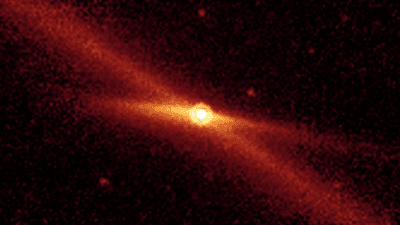


Later this year, you will have an opportunity to get a look at Comet 2P/Encke as it swoops back into our neck of the Solar System. Unfortunately, it will never look as good as it did on April 20, 2007, when NASA's Solar Terrestrial Relations Observatory (STEREO) spacecraft witnessed an event that had never been seen before.
Comet Encke (please forgive us for dropping the 2P, even NASA does it) is a pretty interesting little to average-sized comet, measuring around 4.8 kilometers (2.98 miles) in diameter. While small(ish) now, the comet is believed to be the remnant of a far larger object, which possibly broke apart 10,000-20,000 years ago.
While the comet journeys onwards, and is losing some significant amounts of mass as it gets closer to the Sun and heats up, the other pieces of debris from it now form the Taurid meteor shower, sometimes known as the "Halloween Fireballs", which light up the sky every fall. While one team has found evidence of a major dust release from Encke less than 20,000 years ago deposited in Mercury's atmosphere, possibly due to a collisional event, there is a chance that the Taurid's are merely the result of Encke's parent body plus a long, long time.
"The comet currently has a significant mass-loss rate of ∼ 1010 kg per orbit," a paper on the topic of comets and meteor showers explains. "Considering that the total mass of the Taurid Complex (1013 kg) and a dynamical age of ∼ 104 yr , this seems to imply that sublimation activity from 2P/Encke alone is sufficient to explain the formation of the Taurid Complex if that activity was as strong as today."
So, the comet is part of a body which gave us an annual meteor shower, which is pretty cool by itself. But on April 20, 2007, NASA's STEREO A spacecraft caught the comet colliding with a coronal mass ejection (CME) and witnessed an event never seen before. As the comet, which orbits the Sun every 3.3 years, was hit by the CME its tail was snapped clean off.
"Comet Encke is a short-period comet that circles the Sun every 3.3 years. As the icy rock hurtles through the inner Solar System, it produces two tails: one made of dust and another made of gases. The gas tail, known as an ion tail, points directly away from the Sun, aligning along magnetic field lines within the solar wind," NASA explains.
"But these field lines can be put into complete disarray by a coronal mass ejection (CME), powerful eruptions of plasma and magnetism from the sun. When a CME blew past comet Encke, the wave of solar material disturbed the magnetic field surrounding the comet and snapped its tail off. The effect, however, was only temporary – within minutes a new tail formed."
The dramatic tail-loss can be seen below, please don't be put off by the 2007-era NASA thumbnail.
Later this year – beginning around December – you will be able to look at the comet as it travels from the constellation of Pegasus, through Aquarius and into Capricorn. At around magnitude 5.9 during its closest approach to the Sun on February 10, 2027, and magnitude 6.2 on its closest approach to the Earth on February 3, 2027, the comet should be visible using nothing but a pair of binoculars, though a small telescope would be a significant improvement.
The comet should be visible and reasonably high above the horizon from both hemispheres beginning in December, before slowly lowering out of sight for the Northern Hemisphere by early February, when it will be obscured by the Sun's glare in the twilight sky.
Then, it will only be viewable to viewers in the Southern Hemisphere who are capable of getting up that early. It might be worth it to see such a bright and interesting source of fireballs grace our neck of the Solar System.